China reported a trade surplus for the month of April at $11.4B, up from virtually 0 in March. Exports rose to a record $155.7B (up 2% m/m, 30% y/y) from $152.2B in March and $119.9B in April 2010. Imports slipped month-on-month to $144.3B (down 5% m/m, up 22% y/y), from $152B in March, and $118.2B in April 2010. The return to a monthly surplus will likely accentuate pressure from the US for China to alter its yuan policy, but there are other forces at work which will drive both upward and downward pressure on China's trade balance.
http://seekingalpha.com/article/268994-is-this-china-s-last-trade-surplus
Showing posts with label china trade balance. Show all posts
Showing posts with label china trade balance. Show all posts
Tuesday, May 10, 2011


Monday, April 11, 2011
Latest China Trade Surplus Data Suggests Rebalancing of Chinese Economy
Just a quick update on China's March month and quarterly trade data. The part that everyone's talking about is the quarterly trade surplus of virtually zero. Pretty much a first, it got close to there in the three months to April in 2010. But more on this later. First a quick run down on the stats: Exports were up 36% y/y to $152B, Imports were up 27% y/y to $152B leaving the surplus at basically zero. On a quarterly basis exports and imports were both about $400B, down from the high of $458B and $416B respectively in the 3-months to January 2011.
http://seekingalpha.com/article/262840-latest-china-trade-surplus-data-suggests-rebalancing-of-chinese-economy
http://seekingalpha.com/article/262840-latest-china-trade-surplus-data-suggests-rebalancing-of-chinese-economy
Friday, March 11, 2011
Top 5 Economics Graphs of the Week - 12 Mar 2011
This week the focus is on China and monetary policy. First up we look at China's vital stats for February: inflation, retail sales, industrial production, and international trade. Some of the data is a little distorted due to the holiday season in China, but there are still some interesting insights. Finally we check out some of the seven interest rate changes that various central banks around the world announced over the past week.
1. China Inflation
China reported inflation of 4.9% in February, the same figure as in January. The figure was largely driven by food price inflation, with the prices of foodstuffs rising 11.0% but with non-foodstuffs also showing signs of life, rising 2.3% year on year. The other key category was housing, which rose 6.1%, showing the Chinese housing market is still chugging along, with a mind boggling rate of new buildings under way e.g. the government's 10 million unit social housing program. Overall, food prices are still the key driver, so it will be interesting to see whether food prices may normalize following some of the short-term supply disruptions. But there are also significant wages, capacity, and aggregate demand aspects to inflation, so it's likely that the People's Bank of China has some further tightening up its sleeve.

2. China Retail Sales
February retail sales slumped as expected due to the seasonal effect of the Chinese new year holiday period. However the February figure alone was higher than September 2010 (1.38 trillion yuan vs 1.35 trillion), so the upward trajectory is still firmly entrenched. And it's unsurprising, over the past 5 years urban per capita incomes have doubled to about 20,000 yuan in the 2010 year. The only thing to watch though is the rate of growth has tapered off a bit - this will be a key indicator to monitor over the next few months.

3. China Industrial Production
China recorded growth in industrial production of 14.9% year on year in February (compared to 12.8% growth in February 2010). In terms of sectors the fastest growing were General Purpose Machinery (22.8%), and Nonmetal Mineral Products (18.9%), while the slowest growing sectors were Textiles (8.5%), and Transport Equipment (12.8%). So the message was, basically China's industrial engine is still running strong, and the PMI figures have flagged this. February PMI was about 52 on both measures - indicating expansion. Industrial production is likely to continue to find strength from export demand, property construction demand, and government infrastructure spending demand. But to be sure, over time industrial production will increasingly find strength from domestic demand e.g. in the case of car sales - with massive sales of automobiles in China.

4. China International Trade
On international trade, China reported lower volumes and a -$7.3 billion deficit as seasonal factors bit into trade volumes. However, looking through the seasonal factors, on a rolling quarterly basis, and compared to last year, here's how it would stack up: in the 3 months to February 2010 exports were $400m vs $335m, imports were $390m vs $295m, and the surplus was $12.5m vs $40m. So the volumes are definitely up, but there is some tangible reduction in the trade surplus. Of course some are pointing to this alleviating some of the Yuan debate in the short term, but the PBOC is already starting to acknowledge the role of the Yuan in managing inflation, so watch this space.

5. Monetary Policy Review
On monetary policy, those that raised interest rates included: Thailand +25bps, Kazakhstan +50bps, Korea +25bps, Serbia +25bps, and Peru +25bps. Meanwhile New Zealand -50bps and Trinidad & Tobago -25bps reduced their main policy rates. The rate cuts were the exception, and New Zealand even more of an exception, as the move was motivated as a response to the earthquake. For the most part though the theme was a collective desire to anchor inflation expectations and avoid the second round effects of rising commodity prices. The UK notably didn't do anything, in contrast to the ECB - which suggested rates could rise as early as April. But then we wont be able to know their rationale until the Bank of England meeting minutes come out in a week or so.

Summary
So we saw inflation remaining high in China, which affirms suspicions around a swath of fundamentals that point to broad-based inflationary pressures. On retail sales, consumer spending maintained upward momentum overall, despite the seasonal effects of holidays. Likewise, industrial production showed no let-up, with a variety of factors supporting further strength in China's industrial engine over the medium term. As for international trade, a few quirks saw China report a trade deficit in February, but that's likely to quickly reverse, but there are some interesting trends unfolding. Looking more broadly at the world, the main theme of monetary policy decisions over the past week was the old chestnut of emerging market inflation, with banks looking to preempt second round effects of rising commodity prices. Question is, when's the PBOC's next move?
Sources
1. National Bureau of Statistics www.stats.gov.cn & People's Bank of China www.pbc.gov.cn
2. National Bureau of Statistics www.stats.gov.cn
3. National Bureau of Statistics www.stats.gov.cn
4. China Customs www.customs.gov.cn
5. CentralBankNews.info www.centralbanknews.info
Article Source: http://www.econgrapher.com/top5graphs12mar11.html
1. China Inflation
China reported inflation of 4.9% in February, the same figure as in January. The figure was largely driven by food price inflation, with the prices of foodstuffs rising 11.0% but with non-foodstuffs also showing signs of life, rising 2.3% year on year. The other key category was housing, which rose 6.1%, showing the Chinese housing market is still chugging along, with a mind boggling rate of new buildings under way e.g. the government's 10 million unit social housing program. Overall, food prices are still the key driver, so it will be interesting to see whether food prices may normalize following some of the short-term supply disruptions. But there are also significant wages, capacity, and aggregate demand aspects to inflation, so it's likely that the People's Bank of China has some further tightening up its sleeve.

2. China Retail Sales
February retail sales slumped as expected due to the seasonal effect of the Chinese new year holiday period. However the February figure alone was higher than September 2010 (1.38 trillion yuan vs 1.35 trillion), so the upward trajectory is still firmly entrenched. And it's unsurprising, over the past 5 years urban per capita incomes have doubled to about 20,000 yuan in the 2010 year. The only thing to watch though is the rate of growth has tapered off a bit - this will be a key indicator to monitor over the next few months.

3. China Industrial Production
China recorded growth in industrial production of 14.9% year on year in February (compared to 12.8% growth in February 2010). In terms of sectors the fastest growing were General Purpose Machinery (22.8%), and Nonmetal Mineral Products (18.9%), while the slowest growing sectors were Textiles (8.5%), and Transport Equipment (12.8%). So the message was, basically China's industrial engine is still running strong, and the PMI figures have flagged this. February PMI was about 52 on both measures - indicating expansion. Industrial production is likely to continue to find strength from export demand, property construction demand, and government infrastructure spending demand. But to be sure, over time industrial production will increasingly find strength from domestic demand e.g. in the case of car sales - with massive sales of automobiles in China.

4. China International Trade
On international trade, China reported lower volumes and a -$7.3 billion deficit as seasonal factors bit into trade volumes. However, looking through the seasonal factors, on a rolling quarterly basis, and compared to last year, here's how it would stack up: in the 3 months to February 2010 exports were $400m vs $335m, imports were $390m vs $295m, and the surplus was $12.5m vs $40m. So the volumes are definitely up, but there is some tangible reduction in the trade surplus. Of course some are pointing to this alleviating some of the Yuan debate in the short term, but the PBOC is already starting to acknowledge the role of the Yuan in managing inflation, so watch this space.

5. Monetary Policy Review
On monetary policy, those that raised interest rates included: Thailand +25bps, Kazakhstan +50bps, Korea +25bps, Serbia +25bps, and Peru +25bps. Meanwhile New Zealand -50bps and Trinidad & Tobago -25bps reduced their main policy rates. The rate cuts were the exception, and New Zealand even more of an exception, as the move was motivated as a response to the earthquake. For the most part though the theme was a collective desire to anchor inflation expectations and avoid the second round effects of rising commodity prices. The UK notably didn't do anything, in contrast to the ECB - which suggested rates could rise as early as April. But then we wont be able to know their rationale until the Bank of England meeting minutes come out in a week or so.

Summary
So we saw inflation remaining high in China, which affirms suspicions around a swath of fundamentals that point to broad-based inflationary pressures. On retail sales, consumer spending maintained upward momentum overall, despite the seasonal effects of holidays. Likewise, industrial production showed no let-up, with a variety of factors supporting further strength in China's industrial engine over the medium term. As for international trade, a few quirks saw China report a trade deficit in February, but that's likely to quickly reverse, but there are some interesting trends unfolding. Looking more broadly at the world, the main theme of monetary policy decisions over the past week was the old chestnut of emerging market inflation, with banks looking to preempt second round effects of rising commodity prices. Question is, when's the PBOC's next move?
Sources
1. National Bureau of Statistics www.stats.gov.cn & People's Bank of China www.pbc.gov.cn
2. National Bureau of Statistics www.stats.gov.cn
3. National Bureau of Statistics www.stats.gov.cn
4. China Customs www.customs.gov.cn
5. CentralBankNews.info www.centralbanknews.info
Article Source: http://www.econgrapher.com/top5graphs12mar11.html
Thursday, March 10, 2011
China International Trade Review - February 2011
China just reported its February international trade figures, showing a -$7.3 billion deficit as seasonal factors bit into trade volumes. Exports rose about 2% year on year (falling some -36% month on month), while imports rose almost 20% year on year (also falling -28% compared to January). The key driver of the result was the spring festival (Chinese Lunar New Year) holiday celebrations, with factories shutting down, and workers heading home to their families.
http://seekingalpha.com/article/257487-china-international-trade-review-february-2011
http://seekingalpha.com/article/257487-china-international-trade-review-february-2011
Sunday, January 9, 2011
China International Trade Review - December 2010
China just released its December trade data, which allows an insight into some interesting trends, and of course a look at the full-year and quarterly data. For the month of December China saw exports reach $154.2 billion and imports grow further to a record $141.1 billion. On an annual basis China saw exports reach $1,578.5 billion for the year of 2010 (up 31% vs 2009), and imports at $1,393.9 billion (up 39% vs 2009).

So, really, 2010 was a pretty good year as far as China was concerned on the trade front, both exports and imports made a strong recovery from 2009 and even made ground on 2008 (exports up 10% vs 2008, imports up 23%). Probably the most interesting bit was the pace at which imports grew, and sure some of it was from higher commodity prices, but a lot of it is also just raw growth in import spending.

It was a similar pattern on a quarterly basis, with exports and imports both up vs Q3 (about 3% and 4% respectively), and vs Q4 2009 (about 25% and 29% respectively). So the overall message is a strong recovery in trade volumes, and with imports growing faster than exports. The trend of imports growing faster than exports is a good theme for pretty much everyone, it is potentially the beginning of China starting to pull its weight even more in stoking the global economy, but to be sure this is yet a long road in the transformation and evolution of the Chinese economy.
Sources
Econ Grapher Analytics www.econgrapher.com
China Customs www.customs.gov.cn
Article Source: http://www.econgrapher.com/10jan11-chinatrade.html

So, really, 2010 was a pretty good year as far as China was concerned on the trade front, both exports and imports made a strong recovery from 2009 and even made ground on 2008 (exports up 10% vs 2008, imports up 23%). Probably the most interesting bit was the pace at which imports grew, and sure some of it was from higher commodity prices, but a lot of it is also just raw growth in import spending.

It was a similar pattern on a quarterly basis, with exports and imports both up vs Q3 (about 3% and 4% respectively), and vs Q4 2009 (about 25% and 29% respectively). So the overall message is a strong recovery in trade volumes, and with imports growing faster than exports. The trend of imports growing faster than exports is a good theme for pretty much everyone, it is potentially the beginning of China starting to pull its weight even more in stoking the global economy, but to be sure this is yet a long road in the transformation and evolution of the Chinese economy.
Sources
Econ Grapher Analytics www.econgrapher.com
China Customs www.customs.gov.cn
Article Source: http://www.econgrapher.com/10jan11-chinatrade.html
Friday, October 15, 2010
Top 5 Economics Graphs of the Week - 16 October 2010
This week we look at the recent trade data out of the US and China, then we look at developments in the US inflation situation and what implications it may have. We also review the inflation situation in the EU before reviewing the US consumer sentiment numbers.
1. China Trade Data
First up is the September trade data from China, imports hit a record high at $128.1 billion (24.1% y/y), and exports of $144.9 billion (25.1% y/y) leaving a trade surplus of $16.9 billion. The September quarter also saw trade rising on a quarterly basis with both exports, imports, and the trade surplus rising vs the June quarter; also both exports and imports hit a quarterly record high. The rise in imports is perhaps one of the most interesting aspects in terms of China's role in the global economy. But of course the part getting much of the attention is the trade surplus...

2. US Trade Data
The other big trade data out this week was from the US; the August trade deficit ballooned out to -$46.3 billion, above consensus -$44.3 billion, and July's -$42.8 billion. This time the drivers of the expansion in the deficit were not just from petroleum goods, the nonpetroleum deficit grew to $35.9 billion from $33.2 billion - signaling a cyclical normalisation of the the US trade deficit. The point is that the US trade balance started to head towards zero because of cyclical factors, but it will need to be driven by structural factors if the US is ever going to see a positive trade balance.

3. US Inflation Situation
Also from the US this week was inflation data, which showed a considerably subdued inflation situation in the US. Month on month headline CPI rose 0.1%, and was unchanged on a core basis. Year on year the headline rate reduced from 1.2% to 1.1%, and the core rate fell to 0.8% from 1.0%. However looking at the chart below the ISM prices sub-indexes from both the PMI and NMI show a relatively mixed story - it says that businesses are reporting paying higher prices, which means either an eventual pick up in inflation or margin compression.

4. Euro Zone Inflation Situation
In Europe inflation increased in August, with the headline rate rising to 1.8% from 1.6% in July, but core staying flat at 1%. The main drivers were transport, alcohol & tobacco, and housing. Of course the usual extremes were seen with Ireland facing deflation of -1.0%, followed by Latvia with a 0.3% annual rate; while at the other end were Greece with 5.7% and Romania at 7.7%. Thus at least on a headline basis inflation is by no means gone in the EU, but the message of a fragile, gradual, and uneven recovery for the EU remains

5. Reuters/University of Michigan Consumer Sentiment
Finally, the US Consumer Sentiment index slipped slightly to 67.9 from 68.2 in August, and below consensus 69. The future expectations index fell to 60.9 form 62.9 previous, and the current conditions index rose to 79.6 from 78.3 previously; showing that consumers are slightly happier about things now and slightly less optimistic about the future. Much of the uncertainty is driven by delays on decisions around tax cuts, but also the general uncertainty that accompanies such recovery as the one we're seeing... and of course all the talk about QE2 (which is really an implicit admission by the fed that things are not looking good) will hardly help.

Summary
So we saw China producing record trade results in the September quarter, with the trade balance rising and also raising eyebrows, but of course the continued rise in imports is one of the most interesting features. On the other side of the coin, the US is seeing a cyclical reversal of the ground it made in reducing its trade deficit - the message is that the US will continue to see trade deficits until structural forces drive change.
On the inflation front the US September results showed an exceedingly subdued trend in inflation, but the price indexes in the PMI indexes suggested that the string of disinflation could be temporary (but much will depend on the course of the recovery). Over in the EU the inflation picture was a bit different, with headline rates moving up (but core remaining flat) as the fragile, gradual, and uneven recovery unfolds.
Back to the US, the consumer sentiment figures showed a mixed situation for consumers as uncertainty related to the strength or otherwise of the economic recovery weighs in (in spite of a relatively healthy retail sales figure). So it will be interesting to see if the Fed effectively throws in the towel with another round of quantitative easing. Watch this space!
Sources
1. China Customs www.customs.gov.cn
2. Bureau of Economic Analysis www.bea.gov
3. Bureau of Labour Statistics www.bls.gov & Institute for Supply Management www.ism.ws
4. Eurostat epp.eurostat.ec.europa.eu
5. Reuters/Univesity of Michigan customers.reuters.com
Article Source: http://www.econgrapher.com/top5graphs16oct.html
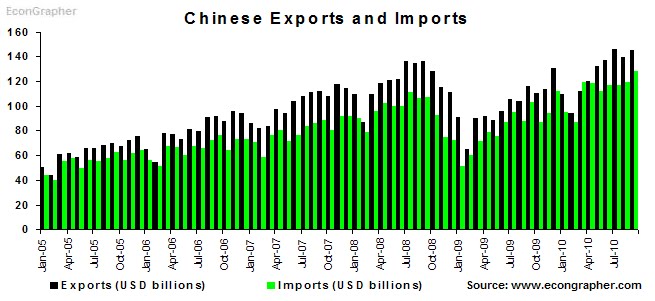
1. China Trade Data
First up is the September trade data from China, imports hit a record high at $128.1 billion (24.1% y/y), and exports of $144.9 billion (25.1% y/y) leaving a trade surplus of $16.9 billion. The September quarter also saw trade rising on a quarterly basis with both exports, imports, and the trade surplus rising vs the June quarter; also both exports and imports hit a quarterly record high. The rise in imports is perhaps one of the most interesting aspects in terms of China's role in the global economy. But of course the part getting much of the attention is the trade surplus...
2. US Trade Data
The other big trade data out this week was from the US; the August trade deficit ballooned out to -$46.3 billion, above consensus -$44.3 billion, and July's -$42.8 billion. This time the drivers of the expansion in the deficit were not just from petroleum goods, the nonpetroleum deficit grew to $35.9 billion from $33.2 billion - signaling a cyclical normalisation of the the US trade deficit. The point is that the US trade balance started to head towards zero because of cyclical factors, but it will need to be driven by structural factors if the US is ever going to see a positive trade balance.

3. US Inflation Situation
Also from the US this week was inflation data, which showed a considerably subdued inflation situation in the US. Month on month headline CPI rose 0.1%, and was unchanged on a core basis. Year on year the headline rate reduced from 1.2% to 1.1%, and the core rate fell to 0.8% from 1.0%. However looking at the chart below the ISM prices sub-indexes from both the PMI and NMI show a relatively mixed story - it says that businesses are reporting paying higher prices, which means either an eventual pick up in inflation or margin compression.

4. Euro Zone Inflation Situation
In Europe inflation increased in August, with the headline rate rising to 1.8% from 1.6% in July, but core staying flat at 1%. The main drivers were transport, alcohol & tobacco, and housing. Of course the usual extremes were seen with Ireland facing deflation of -1.0%, followed by Latvia with a 0.3% annual rate; while at the other end were Greece with 5.7% and Romania at 7.7%. Thus at least on a headline basis inflation is by no means gone in the EU, but the message of a fragile, gradual, and uneven recovery for the EU remains

5. Reuters/University of Michigan Consumer Sentiment
Finally, the US Consumer Sentiment index slipped slightly to 67.9 from 68.2 in August, and below consensus 69. The future expectations index fell to 60.9 form 62.9 previous, and the current conditions index rose to 79.6 from 78.3 previously; showing that consumers are slightly happier about things now and slightly less optimistic about the future. Much of the uncertainty is driven by delays on decisions around tax cuts, but also the general uncertainty that accompanies such recovery as the one we're seeing... and of course all the talk about QE2 (which is really an implicit admission by the fed that things are not looking good) will hardly help.

Summary
So we saw China producing record trade results in the September quarter, with the trade balance rising and also raising eyebrows, but of course the continued rise in imports is one of the most interesting features. On the other side of the coin, the US is seeing a cyclical reversal of the ground it made in reducing its trade deficit - the message is that the US will continue to see trade deficits until structural forces drive change.
On the inflation front the US September results showed an exceedingly subdued trend in inflation, but the price indexes in the PMI indexes suggested that the string of disinflation could be temporary (but much will depend on the course of the recovery). Over in the EU the inflation picture was a bit different, with headline rates moving up (but core remaining flat) as the fragile, gradual, and uneven recovery unfolds.
Back to the US, the consumer sentiment figures showed a mixed situation for consumers as uncertainty related to the strength or otherwise of the economic recovery weighs in (in spite of a relatively healthy retail sales figure). So it will be interesting to see if the Fed effectively throws in the towel with another round of quantitative easing. Watch this space!
Sources
1. China Customs www.customs.gov.cn
2. Bureau of Economic Analysis www.bea.gov
3. Bureau of Labour Statistics www.bls.gov & Institute for Supply Management www.ism.ws
4. Eurostat epp.eurostat.ec.europa.eu
5. Reuters/Univesity of Michigan customers.reuters.com
Article Source: http://www.econgrapher.com/top5graphs16oct.html
Wednesday, October 13, 2010
China International Trade Review - September 2010
China's trade rebound continued in September as global demand normalised as businesses churn through inventory and consumer spending slowly edges up (but well below trend). The September quarter saw trade rising on a quarterly basis with all exports, imports and the trade surplus rising vs the June quarter; with both exports and imports hitting a record high quarterly result in September. Thus marks China's return to pre-crisis levels, but with global demand potentially slowing - led by the subdued recoveries in Japan and the US - China will increasingly need to look internally to drive economic growth (short of further expanding market share of exports, and selling higher margin goods).

Of course the highlight of the September result, or perhaps more - the standout - is the recovery in the trade surplus. The trade surplus is still relatively low historically on both a quarterly, monthly, and rolling annual basis - but is certainly trending upwards. It would still take a significant mentality shift or significant global structural economic changes for the Chinese trade surplus to turn significantly negative. But a negative trade balance should actually be an objective in China's 5-year plan. Such a shift would be the most sustainable for China - perhaps it would also mean that the environmental sacrifice that China has made in the name of economic progress could be reversed or slowed. But in any case the economic and environmental sustainability of the Chinese miracle is a game of huge stakes that the Chinese leadership will need to play carefully and resolutely.

The strategic implications or themes from the trade results include:
1. A continued rise in demand for imports (lead by inputs for production), providing opportunities for trading partners at the country and firm level - which will lead to flow on benefits to those economies and financial results respectively.
2. A continued rise in the trade surplus, which will weigh in on global politics and rhetoric around the so-called currency wars (providing ammo for critics, and raising further the China trade surplus scape-goat flag for US politicians).
3. A strong recovery in volumes for Chinese exporters, which will lift profits for those companies - and potentially lead to eventual wage rises; thus lifting average wages and potentially stimulating domestic demand (and price pressures).
4. The broader threats and opportunities for China and its trading partners at a country and geopolitical strategy level (in terms which direction the leadership of China will focus policy e.g. at an economic level; trade driven or domestic demand driven).
5. The imperative for boosting domestic demand; and the ultimate inevitability of it. This will provide opportunities for those who serve the Chinese consumer, whether they do so from within China (probably the greatest opportunity), or from elsewhere.
Sources
Econ Grapher Analytics www.econgrapher.com
China Customs www.customs.gov.cn
Article Source: http://www.econgrapher.com/13oct-chinatrade.html

Of course the highlight of the September result, or perhaps more - the standout - is the recovery in the trade surplus. The trade surplus is still relatively low historically on both a quarterly, monthly, and rolling annual basis - but is certainly trending upwards. It would still take a significant mentality shift or significant global structural economic changes for the Chinese trade surplus to turn significantly negative. But a negative trade balance should actually be an objective in China's 5-year plan. Such a shift would be the most sustainable for China - perhaps it would also mean that the environmental sacrifice that China has made in the name of economic progress could be reversed or slowed. But in any case the economic and environmental sustainability of the Chinese miracle is a game of huge stakes that the Chinese leadership will need to play carefully and resolutely.

The strategic implications or themes from the trade results include:
1. A continued rise in demand for imports (lead by inputs for production), providing opportunities for trading partners at the country and firm level - which will lead to flow on benefits to those economies and financial results respectively.
2. A continued rise in the trade surplus, which will weigh in on global politics and rhetoric around the so-called currency wars (providing ammo for critics, and raising further the China trade surplus scape-goat flag for US politicians).
3. A strong recovery in volumes for Chinese exporters, which will lift profits for those companies - and potentially lead to eventual wage rises; thus lifting average wages and potentially stimulating domestic demand (and price pressures).
4. The broader threats and opportunities for China and its trading partners at a country and geopolitical strategy level (in terms which direction the leadership of China will focus policy e.g. at an economic level; trade driven or domestic demand driven).
5. The imperative for boosting domestic demand; and the ultimate inevitability of it. This will provide opportunities for those who serve the Chinese consumer, whether they do so from within China (probably the greatest opportunity), or from elsewhere.
Sources
Econ Grapher Analytics www.econgrapher.com
China Customs www.customs.gov.cn
Article Source: http://www.econgrapher.com/13oct-chinatrade.html
Friday, July 9, 2010
China International Trade Review - July 2010
China released its monthly trade figures for the month of June; reporting a trade surplus of $20.2 billion (vs consensus estimates of $15.6 billion), much improved on figures earlier this year, and a surplus of $8.2 billion for the same period of 2009. The outlook is likely for continued trade surpluses for China this year (certainly, it's likely we've seen the bottom level of the rolling annual trade balance), unless global demand and trade volumes slip again; or if the Yuan significantly appreciates.

It's also worth noting within the results, that exports hit $137.4 billion in June, which is at a record level (the previous highest was $136.7 in July 2008), and up strongly compared to last year (up 43.9% year over year vs consensus estimates for 38% growth). Imports also climbed strongly to $117.4 billion (up 34.1% vs an expected 35.4%), reflecting growing demand in a still buoyant (yet potentially slowing) economy, as well as export driven demand (i.e. raw materials as inputs for production of export goods).

So on the trade front China is still doing very well (see quarterly data), and while any yuan impact will be some time coming, there is unlikely to be a major impact from the recent policy adjustment unless the renminbi is allowed to move more than it's small politically driven token concession to date. But again, within the results there are many positives; for one, the fact that exports are growing strong shows that global demand is recovering - or at least remaining steady.
Indeed, given China's importance in international trade, this data should be particularly informative for the state of the global economy. And of course, the rise in imports is a positive - especially for those nations who supply China with its raw materials. The key is, will imports continue to grow? and of interest to the US, can they outpace exports?
Sources
Econ Grapher Analytics www.econgrapher.com
China Customs www.customs.gov.cn
Bloomberg www.bloomberg.com
Article Source: http://www.econgrapher.com/10jul-chinatrade.html

It's also worth noting within the results, that exports hit $137.4 billion in June, which is at a record level (the previous highest was $136.7 in July 2008), and up strongly compared to last year (up 43.9% year over year vs consensus estimates for 38% growth). Imports also climbed strongly to $117.4 billion (up 34.1% vs an expected 35.4%), reflecting growing demand in a still buoyant (yet potentially slowing) economy, as well as export driven demand (i.e. raw materials as inputs for production of export goods).

So on the trade front China is still doing very well (see quarterly data), and while any yuan impact will be some time coming, there is unlikely to be a major impact from the recent policy adjustment unless the renminbi is allowed to move more than it's small politically driven token concession to date. But again, within the results there are many positives; for one, the fact that exports are growing strong shows that global demand is recovering - or at least remaining steady.
Indeed, given China's importance in international trade, this data should be particularly informative for the state of the global economy. And of course, the rise in imports is a positive - especially for those nations who supply China with its raw materials. The key is, will imports continue to grow? and of interest to the US, can they outpace exports?
Sources
Econ Grapher Analytics www.econgrapher.com
China Customs www.customs.gov.cn
Bloomberg www.bloomberg.com
Article Source: http://www.econgrapher.com/10jul-chinatrade.html
Saturday, June 19, 2010
China Announces Yuan (CNY) Flexibility
So China has just announced that it will "Further Reform the RMB Exchange Rate Regime and Enhance the RMB Exchange Rate Flexibility". See the full statement here.
Just what exactly this means remains to be seen, but this is a very positive move, and from a global economic stability standpoint will now allow some of the focus to be shifted towards some of the other sources of imbalances like US (and other developed nations) profligacy both on consumer finances and government finances.
But more on the announcement, and some clues as to what might follow... Here's what happened last time (for some more background on the CNY click here):

They have already explicitly ruled out a large one-off revaluation.
But above all this remains a very positive development in terms of financial and economic reform in China, and a vote of confidence in the Chinese economy:
Sources
Econ Grapher Analytics www.econgrapher.com
People's Bank of China www.pbc.gov.cn
Yahoo Finance finance.yahoo.com
Article source: http://www.econgrapher.com/20jun-cnyflex.html
Just what exactly this means remains to be seen, but this is a very positive move, and from a global economic stability standpoint will now allow some of the focus to be shifted towards some of the other sources of imbalances like US (and other developed nations) profligacy both on consumer finances and government finances.
But more on the announcement, and some clues as to what might follow... Here's what happened last time (for some more background on the CNY click here):

They have already explicitly ruled out a large one-off revaluation.
"China´s external trade is steadily becoming more balanced. The ratio of current account surplus to GDP, after a notable reduction in 2009, has been declining since the beginning of 2010. With the BOP account moving closer to equilibrium, the basis for large-scale appreciation of the RMB exchange rate does not exist."They also noted that the daily +/- 0.50% band will not change:
"In further proceeding with reform of the RMB exchange rate regime, continued emphasis would be placed to reflecting market supply and demand with reference to a basket of currencies. The exchange rate floating bands will remain the same as previously announced in the inter-bank foreign exchange market."So, we're left with no change to the band, and no large one-offs. This leaves a few possibilities like changes in the basket of currencies to which the yuan is pegged. But most likely it will just mean that the authorities there will take a slightly more hands-off approach to the Yuan. So for example we could see a series of daily 0.50% moves. So this may end up in a more flexible market driven state. But of course the point of a market is that prices can move (up or down) depending on demand and supply - and relative prices. So there could even be scope for a depreciation of the Yuan against some currencies.
But above all this remains a very positive development in terms of financial and economic reform in China, and a vote of confidence in the Chinese economy:
"The global economy is gradually recovering. The recovery and upturn of the Chinese economy has become more solid with the enhanced economic stability. It is desirable to proceed further with reform of the RMB exchange rate regime and increase the RMB exchange rate flexibility."And indeed, a vote of confidence in the global economic recovery. The move will also serve to assuage some of the protectionist sentiment that had been rising e.g. US tariffs etc. This is important, because protectionism needs to be avoided at all cost in ensuring the recovery. But above all this announcement may herald the rise of a truly sustainable, and structural global economic recovery.
Sources
Econ Grapher Analytics www.econgrapher.com
People's Bank of China www.pbc.gov.cn
Yahoo Finance finance.yahoo.com
Article source: http://www.econgrapher.com/20jun-cnyflex.html
Friday, June 11, 2010
Top 5 Graphs of the week - 11 June 2010
This week we examine the GDP results from last "BRIC" economy to report, Brazil, then we look at another one; China and see how international trade and retail sales are tracking. Then we analyze the recent US consumer credit data, and finish up with a review of four of the monetary policy decisions this week.
The themes are big ones this week; there's emerging markets leading the recovery, there's global imbalances and potential changes in the make up of the Chinese economy, and finally, monetary policy continues on a de-synchronized path in response to a de-synchronized global economic recovery.
1. Brazil GDP
Brazil reported year on year GDP growth of 9%, smashing the consensus forecasts for 7.6%, and accelerating from the 4.29% in the previous quarter, and -2.14% same time last year. Some of the large number is related to a lower base comparator, but much of it is related to an accelerating recovery in Brazil; highlighting risks of overheating. Indeed the Brazilian central bank ended up raising the Selic rate another 75bps a day or two after the GDP results were announced (see the piece on monetary policy below). So it is good news for the Brazilian economy, it's interesting to see it growing at China levels, but the question of sustainability remains.

2. China International Trade
The Chinese international trade figures for May produced additional ammunition for the yuan bashers, with the surplus growing from about $1 billion in April, to $20 billion in May, and pretty much proving that the March deficit was a one-off cyclical quirk. So exports rose 48.5% year on year, and imports rose 48.3% year on year (mind you, this time last year they were still reporting sub-100 billion dollar figures), month on month imports fell and exports rose. I'm going to repeat that this is going to be an interesting chart to watch in the coming years as the rebalancing of the Chinese economy commences. As I'll note below, the yuan part of it (while still relevant, and unhelpful to be fixed), may start to lose relevance in the case for Chinese economic restructuring driving sustainable growth...

3. China Retail Sales
China reported retail sales of 1.25 trillion yuan in May, up 18.7% year on year (compares to 1.15 trillion in April, with a y/y rise of 18.5%). As with the chart above this is going to be an interesting chart to watch as the Chinese economy begins to draw more and more growth from domestic consumption, and less from an export led strategy. Already there are some high profile wage rise increase stories in the media, with Foxconn being very notable, and the Honda case also being notable (especially given that it is a foreign company, thus there is a bit of a signaling effect that the authorities are allowing it to happen). The point I alluded to above is that as wages rise in China (and they will eventually, driven in part by inflation, driven in part by the new generation and cultural trends). This is probably even a preferable solution to yuan floating, but will eventually have the same effect as wage costs push up export prices and lower competitiveness on a price basis. Watch this space...

4. US Consumer Credit
US consumer credit rose by $1billion in April, matching consensus and beating the previous (downwardly revised) -$5.4 billion. The gain was driven by a $9.4 billion increase in non-revolving credit (reflecting strong car sales), off set by an -$8.5 billion decrease in revolving credit. The chart below shows what looks like a turning of the corner for consumer credit, and this lines up with the trend in the labour market. However arguably this number should still be contracting due to the need for consumer deleveraging to continue, the US personal savings rate was reported as 3.6% in April, which is towards the higher end compared to recent times for the US, but work still needs to be done in deleveraging, and increasing the savings rate (similar but in different direction to the China rebalancing above), for a more structural and sustainable recovery in the US.

5. Monetary Policy Review
In the past week the Reserve Bank of New Zealand increased the official cash rate 25bps to 2.75%, the Banco do Brasil increased the Selic rate 75bps to 10.25%, the Bank of England held at 0.50%, and the European Central Bank held at 1.00%. In a more detailed analysis, I identified that the key trend going on here is that monetary policy stimulus withdrawal continues to be uneven, with different paces matching different prospects, and rightfully so as the global economic recovery looks more and more uneven. So it's synchronised on the way down, just like the stock markets - highly correlated on the way down, but correlations will decrease as the recovery unfolds.

Summary
To re-cap, the Brazilian economy is showing strong growth and adding to the theme of strong growth in emerging markets; a recovery led by emerging markets. But at the same time it also points to the risks for emerging markets, including potential for overheating.
Similarly in China, the new data out this week seems to point in positive directions, but there's more to the surface numbers (if you believe them that is). There are forces in motion in the Chinese economy that will result in an eventual rebalancing of export lead growth to domestic consumption lead growth, and this could happen with or without the yuan if wage increases continue.
Meanwhile in the US, there are weak signs of potential continuation of consumer deleveraging and wealth rebuilding in the consumer credit and savings rate numbers. However it probably wont last, and as with the risk to China's rebalancing; old habits die hard.
Finally, monetary policy stimulus exit is commencing in more places and picking up, but is distinctly de-synchronised, but then so is the economic recovery. Already we've seen it confirmed, emerging markets are growing strong, developed economies are scarcely growing at all. But through all the recovery and stimulus exits, and so-on, it shouldn't be forgotten that with such a disruptive turn of events, there is the opportunity for structural change for a more balanced and sustainably growing global economy.
Sources:
1. Brazil Statistics Agency www.ibge.gov.br
2. China Customs www.customs.gov.cn
3. National Bureau of Statistics www.stats.gov.cn
4. US Federal Reserve www.federalreserve.gov
5. Bank of New Zealand www.rbnz.govt.nz & Banco Central do Brazil www.bcb.gov.br & European Central Bank www.ecb.int & Bank of England www.bankofengland.co.uk
Article Source: http://www.econgrapher.com/top5graphs11jun.html
The themes are big ones this week; there's emerging markets leading the recovery, there's global imbalances and potential changes in the make up of the Chinese economy, and finally, monetary policy continues on a de-synchronized path in response to a de-synchronized global economic recovery.
1. Brazil GDP
Brazil reported year on year GDP growth of 9%, smashing the consensus forecasts for 7.6%, and accelerating from the 4.29% in the previous quarter, and -2.14% same time last year. Some of the large number is related to a lower base comparator, but much of it is related to an accelerating recovery in Brazil; highlighting risks of overheating. Indeed the Brazilian central bank ended up raising the Selic rate another 75bps a day or two after the GDP results were announced (see the piece on monetary policy below). So it is good news for the Brazilian economy, it's interesting to see it growing at China levels, but the question of sustainability remains.

2. China International Trade
The Chinese international trade figures for May produced additional ammunition for the yuan bashers, with the surplus growing from about $1 billion in April, to $20 billion in May, and pretty much proving that the March deficit was a one-off cyclical quirk. So exports rose 48.5% year on year, and imports rose 48.3% year on year (mind you, this time last year they were still reporting sub-100 billion dollar figures), month on month imports fell and exports rose. I'm going to repeat that this is going to be an interesting chart to watch in the coming years as the rebalancing of the Chinese economy commences. As I'll note below, the yuan part of it (while still relevant, and unhelpful to be fixed), may start to lose relevance in the case for Chinese economic restructuring driving sustainable growth...

3. China Retail Sales
China reported retail sales of 1.25 trillion yuan in May, up 18.7% year on year (compares to 1.15 trillion in April, with a y/y rise of 18.5%). As with the chart above this is going to be an interesting chart to watch as the Chinese economy begins to draw more and more growth from domestic consumption, and less from an export led strategy. Already there are some high profile wage rise increase stories in the media, with Foxconn being very notable, and the Honda case also being notable (especially given that it is a foreign company, thus there is a bit of a signaling effect that the authorities are allowing it to happen). The point I alluded to above is that as wages rise in China (and they will eventually, driven in part by inflation, driven in part by the new generation and cultural trends). This is probably even a preferable solution to yuan floating, but will eventually have the same effect as wage costs push up export prices and lower competitiveness on a price basis. Watch this space...

4. US Consumer Credit
US consumer credit rose by $1billion in April, matching consensus and beating the previous (downwardly revised) -$5.4 billion. The gain was driven by a $9.4 billion increase in non-revolving credit (reflecting strong car sales), off set by an -$8.5 billion decrease in revolving credit. The chart below shows what looks like a turning of the corner for consumer credit, and this lines up with the trend in the labour market. However arguably this number should still be contracting due to the need for consumer deleveraging to continue, the US personal savings rate was reported as 3.6% in April, which is towards the higher end compared to recent times for the US, but work still needs to be done in deleveraging, and increasing the savings rate (similar but in different direction to the China rebalancing above), for a more structural and sustainable recovery in the US.

5. Monetary Policy Review
In the past week the Reserve Bank of New Zealand increased the official cash rate 25bps to 2.75%, the Banco do Brasil increased the Selic rate 75bps to 10.25%, the Bank of England held at 0.50%, and the European Central Bank held at 1.00%. In a more detailed analysis, I identified that the key trend going on here is that monetary policy stimulus withdrawal continues to be uneven, with different paces matching different prospects, and rightfully so as the global economic recovery looks more and more uneven. So it's synchronised on the way down, just like the stock markets - highly correlated on the way down, but correlations will decrease as the recovery unfolds.

Summary
To re-cap, the Brazilian economy is showing strong growth and adding to the theme of strong growth in emerging markets; a recovery led by emerging markets. But at the same time it also points to the risks for emerging markets, including potential for overheating.
Similarly in China, the new data out this week seems to point in positive directions, but there's more to the surface numbers (if you believe them that is). There are forces in motion in the Chinese economy that will result in an eventual rebalancing of export lead growth to domestic consumption lead growth, and this could happen with or without the yuan if wage increases continue.
Meanwhile in the US, there are weak signs of potential continuation of consumer deleveraging and wealth rebuilding in the consumer credit and savings rate numbers. However it probably wont last, and as with the risk to China's rebalancing; old habits die hard.
Finally, monetary policy stimulus exit is commencing in more places and picking up, but is distinctly de-synchronised, but then so is the economic recovery. Already we've seen it confirmed, emerging markets are growing strong, developed economies are scarcely growing at all. But through all the recovery and stimulus exits, and so-on, it shouldn't be forgotten that with such a disruptive turn of events, there is the opportunity for structural change for a more balanced and sustainably growing global economy.
Sources:
1. Brazil Statistics Agency www.ibge.gov.br
2. China Customs www.customs.gov.cn
3. National Bureau of Statistics www.stats.gov.cn
4. US Federal Reserve www.federalreserve.gov
5. Bank of New Zealand www.rbnz.govt.nz & Banco Central do Brazil www.bcb.gov.br & European Central Bank www.ecb.int & Bank of England www.bankofengland.co.uk
Article Source: http://www.econgrapher.com/top5graphs11jun.html
Monday, May 10, 2010
China International Trade Review - April 2010
China saw exports rise 30.5% year on year in April to $119.9billion, and imports up 49.7% to $118.24billion, leaving a trade surplus this month of $1.68billion compared to a deficit last month of -$7.24billion. Consensus estimates were for a deficit of -$0.55billion.
The rise in imports, though much of it driven by increasing commodity prices, is a positive sign for global trade and economic activity as China increasingly becomes a driver of world economic growth.

One issue of contention may lie in the results around the squeezing of the Chinese trade surplus, and the obvious implications this may have for the, seemingly much yearned for, Yuan policy adjustment.
The chart below shows the pretty stark decline in the trade surplus over the past year. However how long this trend will continue is up for debate as the rolling 12-month surplus showed signs of stabilizing in April coming in at about $170billion, vs $174billion in March (down from the all time high of $360billion in January 2009).
However, the main downside risks to the trade balance of weak domestic demand and rising commodity prices, could well be persistent - particularly on the demand side as the troubles in Europe threaten to shake up market sentiment and consumer confidence (note, the EU makes up for about 20% of China's exports).

But again, an important takeaway from the results is the surprising resilience that trade volumes have shown since plummeting in early 2009. To be sure, volumes are below trend, but are tracking around pre-crisis levels. But as far as the yuan goes, no matter what angle you take on the trade issue, the European crisis (trillion dollar backstops notwithstanding) could well take away any compulsion that the Chinese may have felt to alter yuan policy.
The data due in the next couple of days though will add to the mix, So watch this space! As a reminder, the data due out this week includes: (consensus vs previous): Consumer Price Index (2.7% vs 2.4%), Fixed Asset Investment (26.1% vs 26.4%), Industrial Production (18.5% vs 18.1%), and Retail Sales (18.2% vs 18%).
Sources
Econ Grapher Analytics www.econgrapher.com
China Customs www.customs.gov.cn
Bloomberg www.bloomberg.com
Article Source: http://www.econgrapher.com/10may-chinatrade.html
The rise in imports, though much of it driven by increasing commodity prices, is a positive sign for global trade and economic activity as China increasingly becomes a driver of world economic growth.

One issue of contention may lie in the results around the squeezing of the Chinese trade surplus, and the obvious implications this may have for the, seemingly much yearned for, Yuan policy adjustment.
The chart below shows the pretty stark decline in the trade surplus over the past year. However how long this trend will continue is up for debate as the rolling 12-month surplus showed signs of stabilizing in April coming in at about $170billion, vs $174billion in March (down from the all time high of $360billion in January 2009).
However, the main downside risks to the trade balance of weak domestic demand and rising commodity prices, could well be persistent - particularly on the demand side as the troubles in Europe threaten to shake up market sentiment and consumer confidence (note, the EU makes up for about 20% of China's exports).

But again, an important takeaway from the results is the surprising resilience that trade volumes have shown since plummeting in early 2009. To be sure, volumes are below trend, but are tracking around pre-crisis levels. But as far as the yuan goes, no matter what angle you take on the trade issue, the European crisis (trillion dollar backstops notwithstanding) could well take away any compulsion that the Chinese may have felt to alter yuan policy.
The data due in the next couple of days though will add to the mix, So watch this space! As a reminder, the data due out this week includes: (consensus vs previous): Consumer Price Index (2.7% vs 2.4%), Fixed Asset Investment (26.1% vs 26.4%), Industrial Production (18.5% vs 18.1%), and Retail Sales (18.2% vs 18%).
Sources
Econ Grapher Analytics www.econgrapher.com
China Customs www.customs.gov.cn
Bloomberg www.bloomberg.com
Article Source: http://www.econgrapher.com/10may-chinatrade.html
Subscribe to:
Posts (Atom)


