Showing posts with label New Zealand employment. Show all posts

Friday, May 6, 2011

Top 5 Economics Graphs of the Week - 7 May 2011

This week we take a look at the Purchasing Manager Index data for the US and China. Then there's a review of the US employment report, before an overview of the employment data from New Zealand, we then wrap up with a review of some of the key monetary policy decisions over the past week.

1. US PMI
The US recorded some relatively disappointing numbers, with the manufacturing PMI falling to 60.4 from 61.2 and the non-manufacturing PMI falling to 52.8 from 57.3. Sure both numbers were still in positive territory, and both still in the expansionary indicator space. But much of the weakness was in the wrong spots, e.g. things like non-manufacturing PMI falling -11.4 points, and new export orders also falling -5.5 points and business activity -6 points. While the manufacturing index saw negatives in production -5.2 points and -1.6 on new orders. However within the manufacturing PMI, there was a 8.5 point increase in backlogs and a 6 point increase in new export orders which are both interesting positives that should point to at least a short term continuation of momentum in manufacturing.

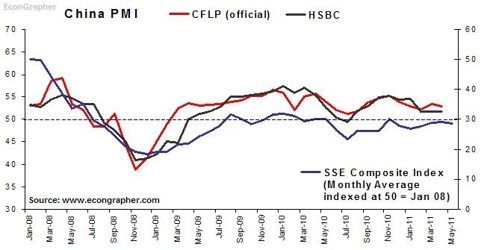
2. China PMI
The official CFLP manufacturing PMI came in at 52.9 in April, down slightly from 53.4 in March, and below the Bloomberg consensus of 53.9. The preliminary HSBC/Markit reading was 51.8, the same as the March reading. The readings show the manufacturing sector in China still in expansionary mode, which bodes well for the Chinese economy. But it could well herald another move by the People's Bank of China, particularly given recent comments that it will continue to fight inflation. Next week is China's monthly data release, where inflation is likely to moderate compared to March's 5.4% reading, but it could be an opportune time for the People's Bank of China to do one last interest rate increase.
3. US Nonfarm Payrolls
The US added 244k nonfarm payrolls in April, up slightly versus March's 221k, and compares to 277k in April 2010. The figure brings 2011 net new nonfarm payrolls to 768k YTD. Less meaningfully, the unemployment rate rose slightly to 9.0% from 8.8% in March. So, all up it was a reasonably positive result. The US economy is finally starting to see consistency in jobs added, and this area will likely be a key aspect for a recovery in consumer spending, and thus a key factor in the housing market, as well as general inflation levels. It's likely that job growth will continue to expand in the months ahead, but as identified in the PMI results, there are due downside risks to the US economy, and an early peak in the PMI could well be negative for the jobs outlook.

4. New Zealand Employment Data
New Zealand reported a 30k increase in jobs through the first quarter of this year, with 20k being part time jobs and 10k being full time. The unemployment rate eased slightly to 6.6%, down from 6.7% in Q4 2010, and off of the peak of 7% in Q4 2009. The employment picture in New Zealand is slowly improving, albeit with the negative contribution from the Christchurch earthquake. But with the rugby world cup event soon approaching there should be a noticeable pick up in part-time jobs, at least in the medium term. After that it's more about how the broader economy can gain momentum and leverage off loose monetary policy, high terms of trade, and one-off boosts. The downside is the need for fiscal tightening, with the government likely to announce a more prudent budget in the next couple of weeks as it seeks to sure up government finances and maintain its AA+ credit rating.

5. Monetary Policy Review
On the monetary policy front, the past week was characterized by continued emerging market policy tightening, and continued developed market policy caution. Of the central banks that made decisions on monetary policy settings this week, those that increased were: India +50bps to 7.25%, Philippines +25bps to 4.50%, and Malaysia +25bps to 3.00%. Meanwhile those that held rates were: Australia 4.75%, Romania 6.25%, United Kingdom 0.50%, European Union 1.25%, and the Czech Republic 0.75%. Next week there's interest rate decisions from Poland (11 May) currently 4.00% , Norway (12th May) currently 2.00%, South Africa (12th) currently 5.50%, and South Korea (13th May) currently 3.00%. Most of these banks will probably increase or maintain a hawkish stance.

Summary

So we saw some relatively disappointing PMI results from the US, but with some glimmers of strength still showing through in the manufacturing index. Over in China there was a slight weakening, but generally things were still strong - perhaps allowing scope for another interest rate increase. Meanwhile the US reported a good nonfarm payrolls figure in April, with some promise for continued strength. Over to New Zealand, the March quarter saw a decent employment report, with a positive outlook as the New Zealand economy looks set to gain momentum. On monetary policy the theme of emerging market tightening continued, and is likely to continue for the time being, meanwhile the overriding theme for developed market central banks was policy caution.

Sources
1. US Institute for Supply Management www.ism.ws & Yahoo Finance finance.yahoo.com
2.
CFLP www.chinawuliu.com.cn & Markit/HSBC www.markiteconomics.com & Yahoo Finance finance.yahoo.com
3. Bureau of Labour Statistics www.bls.gov
4. Statistics New Zealand www.stats.govt.nz
5. CentralBankNews.info www.centralbanknews.info


Article Source: http://www.econgrapher.com/top5graphs7may11.html

Friday, November 5, 2010

Top 5 Economics Graphs of the Week - 6 November 2010

This week we look at the PMI results for China and the US and reflect on their implications. Then we review the monetary policy decisions out over the past week including the announcement from the US FOMC. Then we wrap up with a look at the US employment figures for October, and the New Zealand employment stats for the September quarter.

1. China PMI
China saw a continued rebound in its manufacturing PMI figures for October, with the official CFLP figure rising to 54.7 from 53.8, and the the HSBC index rising to 54.8 from 52.9. Within the CFLP PMI index, the strong points were Production (57.1 vs 56.4), New orders (58.2 vs 56.3), and Inventory (49.5 vs 49.1), while the lower points were Employees (52.1 vs 52.4), and Supplier delivery (49.3 vs 50.4). So overall a reasonably good result, and reflects the continued strength in the Chinese economy - which is showing through into a higher stock market, with the SSE composite rising 15% in October.

2. US PMI
In the US, the October PMI result was also relatively positive with the main index rising to 56.9 from 54.4 driven by strength in new orders, production, and new export orders - with imports falling (a positive sign for net exports). While the non-manufacturing index also rose to 54.3 from 53.2, driven by strength in production, a large spike in prices, and back log of orders. So overall the October results for the US (unless there is some quirk to it) helps provide evidence or support for the non-double-dip scenario. So it is a positive, but at the same time the fundamentals are not quite there yet for economic growth to be anything more than subdued/baseline.

3. Monetary Policy Rates
In monetary policy the main event was the US FOMC announcing the $600 billion asset purchase program, to be implemented at a pace of $75 billion per month. The other major moves were tightening of monetary policy rates in Azerbaijan (100bps), Vietnam (100bps), Australia (25bps), and India (25bps), and loosening of monetary policy rates in Iceland (75bps), and Latvia (12.5bps). Meanwhile other banks held rates due to low inflationary pressures and a desire to keep stimulatory monetary policy conditions to aid the economic recovery e.g. US, EU, UK, Japan.

4. US Nonfarm payrolls
Back to the US, the October nonfarm payrolls pleasantly surprised to the upside, with 151k jobs added in October vs consensus 60k and previous -95k (revised to -41k). Private payrolls grew 159k in October vs 64k in September. Average hourly earnings crept up slightly 0.2% and the average work week was 34.3 hours vs 34.2 in September. So overall, as with the PMI results another good result for the US, a positive from the perspective that it's not going down, but there's still a long way to go before the ground lost during the crisis can be recovered.

5. NZ Employment situation
In New Zealand the Q3 employment report saw the unemployment rate dip to 6.4% from a revised 6.9% in the June quarter. Total persons employed grew by 22k, with part-time jobs increasing 12k and full-time jobs expanding 10k. Across the sectors the jobs growth was relatively broad based with most sectors adding jobs. The figure reflects the progress, albeit slow, being made in the New Zealand economic recovery, but the subdued nature is showing through with deleveraging playing through. One major challenge for New Zealand is the high exchange rate which will impact on net exports, but a key driver of that is weakness in the US dollar. In terms of monetary policy the RBNZ has likely finished tightenings for the year, but will likely continue early next year as the recovery unfolds.

Summary

So we saw relatively strong PMI results in China which showed the economy is still running strong in the middle kingdom. The US also showed strong results in its PMI stats, providing some comfort against the double-dip scenario, but not yet being able to offer more than a subdued, sub-trend economic growth outcome. In monetary policy the major banks are holding tight but other banks are acting as the case demands, with several emerging economies opting to tighten or normalise monetary policy as inflation risks trump growth risks. In employment, the US showed a strong result in October, and New Zealand also showed a pretty good result in Q3. So overall it's a scene of economic recovery, but all is not yet clear and well.

Sources:
1. CFLP www.chinawuliu.com.cn & Markit/HSBC www.markiteconomics.com & Yahoo Finance finance.yahoo.com
2. Yahoo Finance finance.yahoo.com & Institute for Supply Management www.ism.ws
3. CentralBankNews.info www.centralbanknews.info
4. US Bureau of Labor Statistics www.bls.gov
5. Statistics New Zealand
www.stats.govt.nz

Article Source: http://www.econgrapher.com/top5graphs6nov.html

Friday, August 6, 2010

Top 5 Economics Graphs of the Week - 7 August 2010

This week we look at the faltering PMI stats from China, and a relatively stable but mixed PMI result from the US for July. We then review the monetary policy decisions this week from the RBA, BoE, and ECB, then we analyze the employment reports from the US and New Zealand.

1. China PMI
The Chinese PMI indexes both fell in the July reading, with the official CFLP index falling to 51.2 from 52.1, and the HSBC index dipping below 50 for the first time since March 2009, at 49.4 vs 50.4 in June. The PMI numbers are showing an easing of industrial activity in China, but the numbers are still above the low point reached late 2008 to early 2009. The July industrial production result is likely to come in lower again next week when the monthly data release comes out (which also includes CPI, fixed asset investment, PPI, and retail sales). The biggest question around the PMI result is whether or not it's temporary; is it a seasonal movement? is it the result of artificial tightening moves? or is it a more fundamentally driven decline? Next week will surely bring extra pieces to the puzzle.

2. US PMI
In the US the PMI results also softened slightly, but the standout was the non-manufacturing PMI which came in at 54.3 vs 53.8 in the previous month, driven by new orders, and new export orders. The manufacturing PMI on the other hand dropped to 55.5 from 56.2 with the largest falls in new orders and production. The results are symptomatic of where the US economy is tracking; signs of slowing down, but still riding relatively high from the bounce-back - but remember the bounce-back was brought on by the stimulus measures and the inventory cycle. What we're seeing now is the part where the engine is spinning and the clutch is about to engage - but will it stall? the risks are certainly there.

3. Monetary Policy review
This week we saw monetary policy decisions from Australia, Europe, and the UK. The Reserve Bank of Australia held again at 4.50%, which will probably be the new neutral for now; the RBA is basically taking a wait and see approach at this point to gauge how the recovery is tracking in Australia and around the world. The European Central Bank also held steady at the record low 1.00% which was no surprise, likewise the Bank of England help its key rate at 0.50% and held the Asset Purchase Program unchanged at GBP 200 billion. The ECB and BoE are both unlikely to make any substantive tightening moves before the year is out, but of course this depends on how the recovery at home and abroad continues (or otherwise).

4. New Zealand unemployment
Over in New Zealand the quarterly employment report was released for Q2 2010, with the progress made in Q1 almost all lost as the unemployment rate bounced back to 6.8% from 6% in Q1 (but below the high of 7%). Within the results the number of unemployed persons rose 13.9% to 159k, and the number not in the labour force grew 0.6% to 1,094k, while the number of persons employed dropped -0.3% to 2,170k. But within the employment numbers the number of full time employees increased 3k, while the number of part time employees dropped by 7k; which is a relatively positive sign from the perspective that during a recovery its better to see full time jobs growing rather than part-time jobs. The employment situation will likely improve during the second quarter as the economy limps forward on its recovery.

5. US nonfarm payrolls
US nonfarm payrolls fell -131k in July (vs consensus -70k), after falling an adjusted -221k in June. In the detail, 202 government jobs were cut (with 143k being census related), however private payrolls increased by 71k (83k in June). Also in the detail, average hourly earnings increased 0.2% and the average work week increased to 34.2 hours from 34.1 in June. So there are some positives in the payrolls employment report, it is a positive signs to see both hours and earnings on the rise, as well as some growth in the private sector. Of course there's a long way to go to recover the losses made during the crisis, but data like this at least slightly improve the mixed picture of where the US economy is headed.

Summary

So we had China's PMI falling, with the HSBC index tracking into the sub-50 territory, but it remains to be seen whether this is the start of a significant slowdown, or just a temporary pullback. It's likely to be the latter unless any catalysts trigger a more systemic slowdown.

In the US, the PMI's are sending mixed signals, with the non-manufacturing sector improving on the back of increased orders, while the manufacturing sector is slowing as orders fall. Taken together with the employment results it shows a picture of an economy that is muddling its way along out of the recession, with the training wheels of stimulus and the inventory cycle close to falling off...

On the monetary policy front, the theme is simply wait and see. More and more countries are seeing more stop-start activity, with the mixed signals, and slow progress; as we saw with New Zealand's employment figures. More and more the course of domestic monetary policy is looking outwards to the course of the global economy, the easy part of the recovery is officially over - now comes the hard part!

Sources
1. CFLP www.chinawuliu.com.cn & Markit/HSBC www.markiteconomics.com & Yahoo Finance finance.yahoo.com
2. US Institute for Supply Management www.ism.ws
3. Reserve Bank of Australia www.rba.gov.au & European Central Bank www.ecb.int & Bank of England www.bankofengland.co.uk
4. Statistics New Zealand www.stats.govt.nz
5. Bureau of Labour Statistics www.bls.gov


Article Source: http://www.econgrapher.com/top5graphs7aug.html

Friday, May 7, 2010

Top 5 Graphs of the Week - 8 May 2010

This week we look at the consumer credit numbers out of the US, continued expansion in US nonfarm payrolls, surprising growth in NZ employment, Australasian trade numbers, and China's PMI for April (and notes on its currency and monetary policy).

1. US consumer credit expands
US consumer credit expanded $2bn in March, against expectations for a -$3bn contraction (and February's -$11.5). The year on year growth rate is starting to turn up now, signaling that the decline in consumer credit may now be over - or at least that a tentative floor has been found. Looking at the breakdown, Non-revolving credit was the source of the growth, while revolving credit declined. This tells you that much of the growth is driven by things like car sales (which included incentives), rather than consumer spending (revolving credit is generally more associated with general consumer spending). So really, the de-leveraging story still stands for now.

2. US nonfarm payrolls
US nonfarm payrolls surprised to the upside with 290k jobs added in April vs consensus 200k, and an upward revised 230k in March. However the 'official' unemployment rate increased to 9.9% from 9.6% due to a surge in the labor force. Census hiring added 66k to the number (48k in March), in a conveniently timed running of the 10-yearly survey. The expansion in payrolls is a welcome respite for the US, following a mass shedding of jobs as the financial crisis hit. The US tends to take it on the chin with jobs; cutting quickly in bad times, but allowing the necessary adjustments to be made.

3. NZ Employment surprise
Another surprise this week was the jump in New Zealand employment numbers, the unemployment rate fell to 6% from a downward revised 7%; with 22k jobs added. I ran more indepth analysis of the release here. The main points to take are that much of the jobs were added in the productive sector, and it shows that after 3 quarters of positive GDP growth, the economy is finally starting to pick up. Job ads are on the rise, and confidence is also increasing. The scene is almost definitely set now for the RBNZ to raise the official cash rate by 25bps to 2.75% in June (but then there are external risks e.g. Europe, that could play into the mix).

4. Australasian trade
Australia released its international trade figures for March this week, and New Zealand the week before. Australia recorded 2 and 3% growth month on month in exports and imports respectively, with its trade deficit widening to -$2.08bn in March vs -$1.7bn in Feb, and consensus for -$2.13bn. Meanwhile New Zealand reported exports rising higher than imports, recording its 3rd surplus in a row as agricultural commodity prices gave a boost to exports; while demand for imports remained low. It's pretty clear on the chart and in the numbers that the trend for exports and imports has been turning the corner in both Australia and New Zealand.

5. China PMI signals further strength
The HSBC PMI was out this week, slipping slightly to 55.4 from 57 in April (and consensus 57); while the official CFLP PMI rose to 55.7 from 55.1 when it was released in the weekend. So both indexes show the outlook for Chinese manufacturing activity is reasonably strong, in spite of a slight hiccup in February; and firmly rebounding since 2008. Of course the obvious implication is that further strength means further chance for overheating, indeed the People's Bank of China increased the required reserve ratio again last weekend by 50bs, and there has been musings that China will alter its exchange rate policy before the June G-20 meetings.

Summary

Some of the key takeaways from this edition are that the US is still seeing its dubious recovery playing through with some aspects of consumer credit creeping up, and employment beginning to expand through a process of normalisation, stimulus effects, and national surveying. As noted in the analysis of the two US PMI indexes, the US economy is seeing a pick up in activity and signs are for more activity, but the elusive sustainable recovery is yet to be seen.

Looking to Australasia, the growth story continues to play out Australia shows continued strength, and expanding trade (and further interest rate increases - another 25bps this week). Meanwhile New Zealand surprised with its employment numbers, suggesting that the economic recovery there could be picking up; New Zealand also recorded further trade surpluses - but mostly due to cyclical factors. The Australasian economies are islands of growth and stability amongst the developed nations.

Meanwhile - and related to the previous two - China shows no sign of slowing down as the PMIs point to further growth in activity. So the obvious questions of whether or not it's overheating, and what should be done arise. With the PBOC taking a gradualist approach of tinkering with the reserve requirements ratio, will it be forced to take bigger moves soon? The next few months could be most revealing in that respect.

Sources
1. US Federal Reserve www.federalreserve.gov
2. US Bureau of Labor Statistics www.bls.gov
3. Statistics NZ www.stats.govt.nz
4. Australian Bureau of Statistics www.abs.gov.au & Statistics NZ www.stats.govt.nz
5. CFLP: www.chinawuliu.com.cn & Markit/HSBC: www.markiteconomics.com

Article Source: http://www.econgrapher.com/top5graphs8may.html

Wednesday, May 5, 2010

New Zealand Labour Market Turns a Sharp Corner

New Zealand today released its employment data (the Household Labour Force Survey), showing a marked reduction in the unemployment rate from a revised 7.1% in Q4 2009 down to 6% in Q1 2010. Consensus estimates were for no change at the previously announced 7.3% level. And as we conclude in the following analysis, the improvement was for all the right reasons...


As you can see in the chart above, the result is driven by a very strong quarter of jobs growth by historical standards, it also follows some 4 quarters of negative or nil growth. That's one part of the "right reasons" for the turnaround in the unemployment rate, the other part is in the chart below. You can see that not only was the growth in full time jobs one of the highest on record, but it coincided with a decline in part-time jobs (i.e. this indicates a switch from temp/part-time to full time), so this is genuine employment growth, in a genuinely strong labour market.

Much of the jobs growth came from the productive sector, with the Manufacturing sector leading jobs growth (9.2k), while other similar sectors also improved e.g. Construction (2.1k), Wholesale trade (4.1k), and Agriculture (1.2k). The result sent the NZD up about 100 bps against the USD. The New Zealand dollar has climbed almost 30% against the USD over the past year, while the main stock index; the NZSX 50 is up about 12%. The result came shortly after inflation was revealed to have grown 2% in the same quarter.


So now onto the interesting bit; what does this mean? First of all it means, unless there's a major meltdown in Europe, the case for an interest rate rise in New Zealand is growing even stronger. It's almost a certainty now that the RBNZ will raise the OCR in June. But in terms of the wider economy and broader implications, it points to a reasonably robust recovery. Jobs growth is needed to facilitate growth in spending, saving, and asset prices. So feeding this into the economic outlook for New Zealand paints a reasonably promising picture, but it is still early days, and there's still a lot of hard work to be done to get back to trend.


Things to watch for in New Zealand:
  • May 20 - Budget announcement (including tax reforms, which the government has signalled may include rises in the Goods and Services tax, lowering of personal income tax rates, and tightening up of investment property tax loopholes).
  • June 10 - RBNZ Monetary Policy Statement (which will likely include increasing the OCR 25bps to 2.75%).

Sources:
Econ Grapher Analytics www.econgrapher.com
Statistics New Zealand www.stats.govt.nz

Article Source: http://www.econgrapher.com/6may-nzjobsmarket.html

Friday, February 5, 2010

Top 5 Graphs of the Week - 6 February 2010

In this edition we look at the positive signs in the US PMI release, more 'less-bad' data in US nonfarm payrolls, the RBA pausing on its road to neutral policy, the BoE and ECB keeping policy easy, and New Zealand employment. If there's any theme to it all, it could be an employment and monetary policy theme.

Indeed, it would be interesting to think about things around this theme, because these indicators are likely to tell you where the recovery is at (e.g. faster recovery = jobs growth, and monetary policy tightening). At the same time it could tell you where the recovery might be going too (e.g. easy monetary policy stimulates - or perhaps even over-stimulates activity, slow job growth impacts on consumer deleveraging).

1. US ISM PMI - Onwards and Upwards?
The main index came in at 58.4 for January vs 54.9 in December and beating consensus of 55.0. This was a pretty positive report overall, and pointed to a continuation of the momentum spurred on by stimulus measures and the inventory cycle. One of the key features again was the state of New Orders, the green line in the chart below, this leading indicator points to what will likely be another strong quarter of economic activity in Q1 2010. There were other interesting points in the report too, e.g. the prices index jumped further to 70, the exports index grew faster than the imports index, the employment index showed net positive hiring, and inventory levels still showed up as being too low.


2. US Nonfarm Payrolls - Rolling Along
The US saw further "improvement" in the change of nonfarm payrolls, as January saw only -20k jobs lost. Another positive was the November figure, which was revised up to positive 64k. The downside was several large downward revisions - so overall the situation is a little worse than initially reported due to methodological quirks - you can see the BLS release for specifics. The overall message to take though is that the trend is still going in the right direction for less losses, and towards eventual gains. The negative is that the job losses have been significant and this will impact on consumer deleveraging, and ultimately end up depressing consumer spending over the medium term.


3. RBA Pauses its Monetary Policy Normalisation
The Reserve Bank of Australia kept its key interest rate unchanged this time at 3.75% after 3 consecutive hikes of 25 basis points - away from "emergency settings". The drivers of this decision were basically that the banks had passed the rate hikes to borrowers; and then some (estimated about 1% extra), and being increasingly coupled to the Chinese economy, the commencement of tightening that occurred there. The decision also reflects a view that inflation is relatively contained for now, and that the best course is to monitor how the recovery unfolds. Of note though, it signalled a return to tightening at some point given that interest rates still remain "below average".


4. ECB and BoE Keeping it Easy

Both the ECB and the BoE kept monetary policy conditions easy in their decisions this week. The BoE effectively paused its asset purchase program, having made purchases up to the full GBP 200 billion limit. They noted that the next step for that will depend on how things unfold - and given the state of the UK economy, the next move will probably be more purchases. The ECB noted that it will make decisions about some of the extraordinary policy moves it took, in March. The ECB carried on the same general sentiment about subdued and uneven growth, contained inflationary conditions, and of course the need for explicit and proactive fiscal policy exit strategies (and not just Greece).


5. New Zealand Employment

New Zealand reported its employment figures for Q4 2009, showing an increased unemployment rate thanks to more people look for jobs, and less Kiwis going offshore to find work (one of the main places to go is the UK - and well...). But within the result the actual number of persons employed basically went sideways (well, down -0.1% q/q), which paired with the recent 2 quarters of positive GDP growth could well point to a bottoming out or even turning point for jobs in New Zealand. Looking at the chart below, you can also see that the quarterly change in full time jobs is showing tentative moves toward the zero mark. The outlook for the New Zealand economy is broadly similar to their Australian neighbor, but simply not as good.


Summary
To sum up, the strongly improved PMI result had various positive elements to it, and more importantly; pointed to a further pick up of activity for the US in Q1 2010. Alongside this the nonfarm payroll figures pointed to a gradually improving situation, but also hinted at factors that may impede recovery of consumer demand. Together these paint a picture of a strong improvement, followed by more subdued activity i.e. the "W" or "square root" shaped recovery.

Looking abroad, the pause in Australian monetary policy tightening is not a negative signal, if anything it is a positive one, it means monetary policy will remain stimulatory there, and that for now inflation is reasonably contained. Over in the Euro area though, the continued inaction in monetary policy shows that things are still pretty grim there, though improving unevenly.

The critical message in the ECB statement for many of the members of the EU and elsewhere is the need for some fiscal discipline and proper plans for exit strategies from fiscal stimulus. The example of what not to do is Greece, and the potential ramifications there of not acting appropriately - though still unfolding - should strike fear into the hearts of any politicians and investors alike wise enough to foresee them.

Sources:
1. US ISM http://www.ism.ws
2. US Bureau of Labor Statistics http://www.bls.gov
3. Reserve Bank of Australia http://www.rba.gov.au
4. ECB & BoE http://www.ecb.int & http://www.bankofengland.co.uk
5. Statistics New Zealand http://www.stats.govt.nz


Article Source: http://econgrapher.site1.net.nz/top5graphs6feb.html