Showing posts with label New Zealand GDP. Show all posts

Friday, March 25, 2011

Top 5 Economics Graphs of the Week - 26 Mar 2011

This week we take a look at the December quarter economic growth statistics coming out of three very different developed economies. First up is US, with strongest growth of the three, then France, and New Zealand. We also take a look at the rising UK inflation figures and think about what they mean for the Bank of England. Finally we review some emerging market monetary policy tightening moves over the past week, which point to growing opportunities and risks for emerging market equities.

1. US GDP
The US saw 4th quarter 2010 GDP revised up, with the final reading showing the US economy rose 3.1% on a seasonally adjusted annualized rate in Q4. The reading compares with 2.8% in the previously released result, and is up from Q3's 2.6%. The upward revision reflected stronger inventories, non residential building investment, equipment and software investment, and even residential investment. The results reflect the theme of a manufacturing lead recovery, with business starting to become more confident in investing in their business, and gradually rising internal and external demand. The US economy is likely to gain momentum through 2011, with corporate earnings likely to also gain momentum as analyst forecasts for S&P 500 earnings point to growth as great as 15% year on year in H2 2011. However there are due downside risks, such as the state of the global economy, and the US fiscal situation.

2. France GDP
France reported GDP growth of 0.4% in Q4, revised up from 0.3% (with third quarter GDP being revised down to 0.2% from 0.3%), and placing GDP up 1.5% on an annual basis. The figure was boosted by a rise in household consumption expenditure, with final domestic demand making a positive contribution, and investment growth making a marginal contribution. Net exports also positively contributed as import demand slowed. Inventories had a net negative contribution. The Bank of France is forecasting economic growth to gain momentum this quarter, with growth expected to come in at around 0.8% in 1Q11. Also of interest was the French consumer confidence numbers, which showed consumers concern with inflation taking precedence over concerns with unemployment, confirming comments by the European Central Bank on the risks of second round inflation effects from rising commodity prices.

3. New Zealand GDP
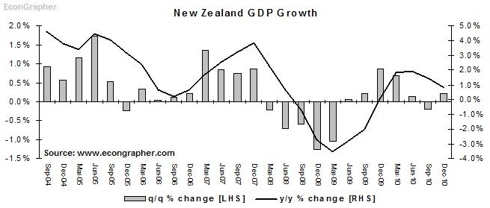
The New Zealand economy grew 0.2% q/q in the December 2010 quarter (-0.2% 3Q10), placing it up 0.8% year on year (1.5% 3Q10). The strongest sectors on a quarterly basis were fishing, forestry and mining, manufacturing, construction, and personal and community services. While the worst performing sectors were wholesale trade, retail, accommodation and restaurants, and utilities. So it was basically the primary sectors doing well, with the consumer sector still struggling. Thus the results overall were hardly spectacular, but the outlook is more promising, with the earthquake rebuilding effort likely to start making positive contributions as early as H2 2011. In addition, the Rugby World Cup will also add tourism revenues and boost the consumer sector. High agricultural commodities will boost the primary exporting sector, particularly dairy. And loose monetary policy will also assist the economic recovery.
4. UK CPI
The United Kingdom fell prey to the global inflation trend, with its annual CPI inflation rate rise to 4.4% in February this year, beating expectations of 4.2%, and rising from 4.0% in January. The figure will no doubt irk the Bank of England, which is likely to come under increasing pressure to raise rates from excessively stimulatory levels (0.50%). Indeed, in its most recent meeting minutes the Bank of England noted it is likely that inflation will rise to as much as 5% or more, before normalizing, with the Bank expecting inflation to fall back to the official inflation target of 2% in 2012. Inflation in the UK is still being boosted by the one-off effect of sales tax rises, and the impact of strong commodity prices. While these are in theory one-off/temporary effects, there is still a risk that inflation expectations may rise. Provided the economic situation doesn't materially deteriorate it is likely the BoE will start normalizing monetary policy before long.

5. Monetary Policy
The week in monetary policy was characterized by further emerging market monetary policy tightening with the following central banks lifting policy rates: Nigeria +100bps to 7.50%, Kenya +25bps to 6.00%, Uruguay +100bps to 7.50%, and the Philippines +25bps to 4.25%. Meanwhile two Central Banks held their policy rates, but tightened reserve requirements; Turkey +300bps to 15%, and Russia +100bps to 5.5% (and +50bps to 4%). For emerging markets, monetary policy continues to be the wild card. If emerging markets are able to tackle the inflation challenge successfully without growth taking too much of a hit then emerging market equities are likely to bring in strong returns - especially coming off current modest/reasonable valuation levels. However the obvious flip side is the policy risk puzzle, with the possibility of hard landings coming from over-tightening.


Summary

So we saw the US revising its GDP growth numbers upward as the US economy gained momentum, with all signs pointing to a strong 2011 - but with due downside risks. France likewise upgraded its GDP numbers in Q4 2010, but with momentum rising, also showed signs of rising inflationary pressures. Meanwhile New Zealand reported a marginally positive but relatively weak Q4 GDP result, but with the conditions coming into place to support a strong 2011, particularly in the later half of the year. Over to the UK, British inflation rose further, adding increasing pressure on the Bank of England to start normalizing monetary policy. While emerging markets continued their monetary policy tightening campaign to rein in rising inflation on the back of commodity prices and strong economic growth.

Sources
1. US Bureau of Economic Analysis www.bea.gov
2. OECD Statistics Database stats.oecd.org
3. Statistics NZ www.stats.govt.nz
4. Trading Economics www.tradingeconomics.com
5. CentralBankNews.info www.centralbanknews.info

Article Source: http://www.econgrapher.com/top5graphs26mar11.html

Thursday, March 24, 2011

New Zealand Quarterly Economic Check-up: Mildly Positive With Attractive Alpha Equities

New Zealand just saw the release of two key economic statistics: its current account and Gross Domestic Product. While both data points were mildy positive, due consideration needs to placed on the detail in order to understand the outlook and implications for investing. On GDP, the New Zealand economy grew 0.2% q/q in the December 2010 quarter (-0.2% 3Q10), placing it up 0.8% year on year (1.5% 3Q10). Meanwhile the current account came in as -2.3% of GDP (from -2.2% in 3Q2010).

http://seekingalpha.com/article/259922-new-zealand-quarterly-economic-check-up-mildly-positive-with-attractive-alpha-equities

Wednesday, December 22, 2010

New Zealand Q3 GDP - The Details

New Zealand saw an unexpected contraction in GDP in the September quarter, recording a -0.20% decline from the June quarter. On a year on year basis GDP was up 1.50% which was lower than consensus estimates for 1.80% growth. Much of the weakness was due to a minor loss of momentum and the impact of the Christchurch earthquake. However there are several reasons why this will likely be the low point as 2011 is set to be a strong year for economic growth in New Zealand.


Digging into the details on an expenditure approach, the chart below shows the breakdown, with residential buildings have the most significant negative impact in the quarter, and with net exports also having a negative impact (i.e. through higher imports and lower exports). Government expenditure also decreased as the government looked to cut costs, having recently been put on negative credit watch by Standard & Poor's. The residential buildings aspect is likely to be a positive contributor over the next year as rebuilding efforts take place in Christchurch, broadly this effect will add to overall GDP growth over the medium term.


On a sector basis, the most significant detractor was fishing, forestry and mining (mining will likely also fall somewhat as the Pike river coal mine disaster has seen the mine closed for the foreseeable future), with construction and manufacturing also falling. Slightly offsetting that was transport and communication and wholesale trade; which is a positive sign for the broader economy. The retail, accomodation and restaurants sector will likely receive a significant boost through 2011 as New Zealand hosts the Rugby World Cup (go the all blacks!).


So overall it was a negative result, but this was largely due to the short-term impact of the earthquake. Going into 2011 the New Zealand economy will likely pick up steam as the impact of the post-earthquake rebuilding, Rugby World Cup, still relatively loose monetary policy, and a general gathering of momentum underpin the recovery.

Sources
Econ Grapher Analytics www.econgrapher.com
Statistics NZ www.stats.govt.nz

Article Source: http://www.econgrapher.com/23dec-nzgdp.html

Saturday, December 18, 2010

Economic Calendar - 19 Dec 2010

Here's the Economic Calendar for the week commencing the 19th of December 2010. This week there's New Zealand Q3 GDP results, as well as further revisions to the Q3 GDP results from the UK and US, New Zealand also puts out its 3rd quarter current account data. On the monetary policy front, the Bank of Japan will review policy, and the RBA and BoE will release minutes from their recent policy meetings. Elsewhere there's Canadian CPI, Japanese exports, and US consumer sentiment numbers.

(More commentary follows the table)

Date GMT Country/
Currency
Event Forecast Previous
MON 09:00 EUR Euro-Zone Current Account n.s.a. (OCT)
-9.2B
MON 09:00 EUR Euro-Zone Current Account s.a. (OCT)
-13.1B
MON 15:00 EUR Euro-Zone Consumer Confidence (DEC A) -9.00 -9.40
MON 21:45 NZD New Zealand Net Migration SA (NOV)
680.00
MON 00:30 AUD Reserve Bank's Board December Minutes

MON 04:30 JPY All Industry Activity Index (MoM) (OCT) -0.20% -0.80%
TUE 05:00 JPY Bank of Japan Rate Decision (DEC) 0.10% 0.10%
TUE 07:15 CHF Trade Balance (Swiss franc) (NOV)
2.10B
TUE 09:30 GBP Public Finances (PSNCR) (Pounds) (NOV) 12.3B 2.4B
TUE 09:30 GBP Public Sector Net Borrowing (Pounds) (NOV) 16.8B 9.8B
TUE 12:00 CAD Consumer Price Index (YoY) (NOV) 2.30% 2.40%
TUE 12:00 CAD Bank Canada CPI Core (YoY) (NOV) 1.60% 1.80%
TUE 13:30 CAD Retail Sales (MoM) (OCT) 0.50% 0.60%
TUE 13:30 CAD Retail Sales Less Autos (MoM) (OCT) 0.70% 0.40%
TUE 21:45 NZD Current Account Balance (3Q) -2.304B -0.880B
TUE 21:45 NZD Current Account Deficit-GDP Ratio (3Q) -3.40% -3.00%
TUE 23:50 JPY Merchandise Trade Balance Total (NOV) ¥481.7B ¥821.3B
TUE 23:50 JPY Adjusted Merchandise Trade Balance (NOV) ¥626.3B ¥578.5B
TUE 23:50 JPY Merchandise Trade Exports (YoY) (NOV) 10.30 7.80
TUE 23:50 JPY Merchandise Trade Imports (YoY) (NOV) 9.00 8.80
WED 09:30 GBP Total Business Investment (QoQ) (3Q F) -0.20% -0.20%
WED 09:30 GBP Gross Domestic Product (QoQ) (3Q F) 0.80% 0.80%
WED 09:30 GBP Gross Domestic Product (YoY) (3Q F) 2.80% 2.80%
WED 09:30 GBP Bank of England Minutes (DEC)

WED 09:30 GBP Total Business Investment (YoY) (3Q F) 4.60% 4.60%
WED 13:30 USD Gross Domestic Product (Annualized) (3Q T) 2.80% 2.50%
WED 13:30 USD Gross Domestic Product Price Index (3Q T) 2.30% 2.30%
WED 15:00 USD House Price Index (MoM) (OCT) -0.10% -0.70%
WED 15:00 USD Existing Home Sales (NOV) 4.75M 4.43M
WED 21:45 NZD Gross Domestic Product (QoQ) (3Q) 0.10% 0.20%
WED 21:45 NZD Gross Domestic Product (YoY) (3Q) 1.80% 1.90%
THU 13:30 CAD Gross Domestic Product (MoM) (OCT) 0.30% -0.10%
THU 13:30 USD Personal Income (NOV) 0.30% 0.50%
THU 13:30 USD Durable Goods Orders (NOV)
-3.30%
THU 13:30 USD Durables Ex Transportation (NOV)
-2.70%
THU 13:30 USD Personal Spending (NOV) 0.50% 0.40%
THU 13:30 USD Personal Consumption Expenditure Deflator
1.30%
THU 13:30 USD Initial Jobless Claims (DEC 18) 420K 420K
THU 13:30 USD Personal Consumption Expenditure Core 0.90% 0.90%
THU 14:55 USD U. of Michigan Confidence (DEC F) 74.50 74.20
THU 15:00 USD New Home Sales (NOV) 300K 283K

As noted, New Zealand will release its Q3 GDP results this week, with expectations for a slight slowing of growth to about 0.10% q/q or 1.8% y/y. The US and UK will also announce further revisions to their Q3 GDP results, with the US expected to slightly revise up its results. Canada will also release its monthly GDP stats for October.

On Monetary Policy the Bank of Japan is set to meet early this week, with no expectations for interest rate changes, and a low chance of other adjustments - but it will be worth keeping an eye on as the Tankan results were less than impressive. There's also the monetary policy meeting minutes from the Reserve Bank of Australia and the Bank of England. The Bank of England notes will be worth a look as the BoE does not include much details in their initial rate announcements.

Elsewhere, there's CPI data due out of Canada, with a slight slowing of inflation expected; then there's Japan merchandise trade data for November with improvements expected; the US has existing home sales and new home sales data out; and the US also has the University of Michigan consumer sentiment survey results out for December.

So as always, have a great week, watch out for surprises, and stay tuned for updates...

Sources
DailyFX www.dailyfx.com/calendar
Forex Pros www.forexpros.com/economic-calendar/
Forex Factory www.forexfactory.com/calendar.php
Bloomberg www.bloomberg.com
+various statistics websites and central bank websites for verification


Article Source: http://www.econgrapher.com/19dec-calendar.html

Friday, November 26, 2010

New Zealand Markets - Worth a Look?

Here's an update on the New Zealand markets. First up is a look at the currency, the NZD (also known as the "Kiwi") took a bit of a dive in the past week or so on the back of a few things; first there was the Ireland and wider sovereign worries in the EU, this took some of the risk off - and since the NZD is considered a risk currency i.e. correlated with equities, the NZD has also taken a bit of a fall. Which is unsurprising, as the NZD is more or less at the mercy of what the USD is doing in this pair. The other big thing that happened to knock it down a bit was the Standard and Poor's announcement putting New Zealand's sovereign rating on negative outlook (rated AA).


The question is, will these events be the catalyst that starts the Kiwi into free fall? Make no mistake about it, the NZD is well overpriced against the USD at the moment when you considered the fundamentals. It is well beyond the PPP rate, and is still at the high end of it's historical trading range, and quite a distance from the mean. So it wouldn't be surprising if the NZD did fall further, but of course, the USD could stop that if there were further weakness in the dollar. And of course as one of the carry trade currencies, monetary policy will also play a role.


And what of New Zealand equities? The valuations are still relatively attractive, and it's a good market to generate dividend income, with many high yielders on the NZX. On NZ equities, if you can't gain access to the New Zealand stock market directly there is the recently launched ETF; ENZL which so far is up about 10% since inception, and has clocked up about $55 in net assets. But one of the biggest attractions about the New Zealand market is its low rate of broker research coverage. This means the benefits to be garnered from doing additional research are much higher than e.g. the US, which means opportunities for relatively easy alpha capture. But on the economic outlook front, the prospects are probably similar to the US; the recovery is underway, but growth will almost certainly be sub-trend for a period. Macro aside, it's worth a look.

Sources
Econ Grapher Analytics www.econgrapher.com
Yahoo Finance finance.yahoo.com
Global View Forex www.global-view.com

Article Source: http://www.econgrapher.com/27nov-nzmarkets.html

Thursday, September 16, 2010

RBNZ Holds OCR at 3.00%, Notes Earthquake Impact

The RBNZ (Reserve Bank of New Zealand) left the OCR (Official Cash Rate) unchanged at 3.00%, leaving banks' core overnight funding costs unchanged. The decision was expected by most, with most economists in New Zealand expecting the next move not to come until as late as December this year.

The RBNZ also released its detailed economic analysis report; the Monetary Policy Statement, where it outlined its views on the New Zealand economy and rationale for the decision. The Bank noted that (as with the expectations of those in the market) further tightening of monetary policy is likely to be more drawn out:
“Over time, it is likely that further removal of monetary policy support will be required. The pace and extent of further OCR increases is likely to be more moderate than was projected in the June Statement.”


The New Zealand Economy
In its assessment of the New Zealand economy the RBNZ noted the likely impact of the Christchurch earthquake (see below for more details), but it also honed in on the slowing of the pace of the global economic recovery; in particular in the US. But pointed out that New Zealand's key trading partners; China and Australia are both growing strong and will likely support demand for exports.

However the RBNZ did note the decline in the outlook for the household sector as deleveraging runs its course; thus resulting in a relatively subdued housing market and lackluster consumer spending. On the inflation front, unsurprisingly the RBNZ did not see significant underlying inflationary pressure, but did note the likelihood of a spike in short-term inflation.
“Overall, despite the weakened outlook, we still expect that growth will progressively absorb current surplus capacity over the next few years. In addition, changes to indirect taxes and earthquake impacts will cause headline inflation to spike higher over the coming year. Previous experience of GST increases, the fact that annual CPI inflation has been near 2 percent for the past year and a half, and the subdued state of domestic demand suggest this inflation spike will have little impact on medium-term inflation expectations."

Earthquake Impact
The RBNZ noted the potential economic impact of the 4th of September earthquake (7.1 magnitude). The earthquake significantly damaged buildings and infrastructure, and thus will have a short term negative impact on the economy; but over the medium term it is expected that there will be a net benefit to the economy with insurance payouts and reconstruction stimulating the faltering building and construction sector.
“The earthquake that struck Canterbury on 4 September has significantly disrupted economic activity and is likely to continue to do so for some time yet. Many homes and businesses have been damaged, as have significant parts of Canterbury’s public infrastructure. Eventual reconstruction and repairs will require considerable resources over the next year or two, particularly in the construction sector. If, in the aftermath of the earthquake, the prices of some goods and services increase temporarily, monetary policy would remain focused on the medium-term trend in inflation. The Policy Targets Agreement explicitly instructs the Bank to look through temporary price increases generated by a natural disaster."

Summary
Overall the RBNZ confirmed my previous suspicion that tightening would be on the go-slow for the rest of the year with perhaps only one more 25bp increase. As far as the New Zealand economy is concerned, the recovery is still relatively well entrenched, but GDP growth is likely to come in slower in the second half of 2010. There may well be a few quarters of slower growth, but 2011 promises to bring stronger growth as the economy rebounds driven by exports, earthquake rebuilding in Canterbury, and the 2011 Rugby World Cup.

In terms of gaining exposure to the New Zealand economy, you can play the volatile NZD exchange rate, or invest in one of the New Zealand ETFs e.g. iShares MSCI New Zealand Invest (ENZL), Wisdom Tree Dreyfus New Zealand Dollar (BNZ), or through one of the ETFs listed on the New Zealand Stock Exchange (NZX.nz) such as the top 50 stocks fund (FNZ.nz); or of course directly into stocks listed on the NZX or dual listed on the ASX.

Sources
Econ Grapher Analytics www.econgrapher.com
Reserve Bank of New Zealand www.rbnz.govt.nz
Statistics New Zealand www.stats.govt.nz

Article Source: http://www.econgrapher.com/16sep-rbnz.html

Thursday, July 29, 2010

RBNZ raises OCR to 3.00%, signals go-slow

The RBNZ (Reserve Bank of New Zealand) increased the official cash rate at its July meeting 25bps to 3.00%, and signaled that further rate rises will likely be on the go-slow. It noted that policy normalization may be more moderate going forward, but of course with the caveat of monitoring the economic environment and financial market developments:
"Given this, some further removal of monetary policy stimulus is appropriate at this stage. Even after today’s move, the level of the OCR is still very supportive of economic activity. The pace and extent of further OCR increases is likely to be more moderate than was projected in the June Statement. Our policy assessment will be continually reviewed in light of economic and financial market developments."

Indeed, this is probably the correct approach as the policy rate is still well below average, and is certainly in the stimulus zone, but against a backdrop of still subdued economic activity (recovery yes, but below trend, yes too). The New Zealand economy is in recovery mode and is growing, but is still dealing with the damage from the global financial crisis and the deep recession; as well as a spate of finance company collapses, beginning prior to the crisis and still continuing (the banking system remains firmly intact though, as none of the finance companies were particularly systemically important - but a lot of investors got burned).
"In New Zealand, domestic demand is subdued. Households are cautious, with retail spending growing only modestly, housing turnover in decline and household credit growth weak. While this caution has been evident for some time, the recent slowing in net immigration will act to further dampen consumer spending. Business investment remains very low, with corporate lending continuing to be subdued."

On the inflation front though, the headline inflation rate is widely expected to temporarily spike above 3% as government related price changes e.g. GST come into force. However the RBNZ does not expect this to translated through into core inflation, but there is the risk that firms and households raise their inflation expectations as a result, and that could lead to more genuine inflation. So the outlook seems fairly predictable for New Zealand, the main wild-cards come from abroad, both upside and downside.

Sources
Econ Grapher Analytics www.econgrapher.com
Statistics New Zealand www.stats.govt.nz
Reserve Bank of New Zealand www.rbnz.govt.nz

Article Source: http://www.econgrapher.com/29jul-rbnz.html

Friday, June 25, 2010

Top 5 Graphs of the week - 26 June 2010

This week we look at the progress of the economic recovery in New Zealand, examine the latest US consumer sentiment statistics, then review CPI data from Canada and Japan, and finish up with a review of the trade data from Japan this week. The word gradual pops up several times, and is consistent with the theme of a broadly gradual global economic recovery.

1. New Zealand GDP
New Zealand recorded its 4th quarter of positive GDP growth with 0.6% q/q for the March quarter of 2010. This matched consensus estimates, but was down slightly from the 0.9% recorded in the December quarter of last year; reflecting the somewhat subdued economic recovery, following one of the worst recessions in decades. The growth mostly came from the primary sector and manufacturing sector. New Zealand also reported its current account numbers, showing a current account deficit to GDP ratio of -2.4%, the lowest in more than a decade. Overall the NZ economy is in recovery mode, with the central bank already lifting interest rates, but as I mentioned previously, it's onwards, but only slightly upwards.


2. US Consumer Sentiment
The US consumer sentiment report for June showed a level of 76.0 for the final reading, up from the May reading of 73.6, with an improvement in the current conditions component to 85.6 from 81 in May; the highest in about 2 years. The future expectations component only rose slightly to 69.8 from 68.8 in May. The index is starting to see gains as employment conditions have seen improvements due to some one-offs such as the census, but also genuine jobs normalization (not growth, but normalization - i.e. corrections to overreactions during recession). The results are consistent with a seemingly sustained, yet gradual in the US.


3. Canada Inflation
Canada reported an annual inflation rate of 1.4% in May, following a rise of 1.8% in April. The slightly slower rate reflected a moderation in gasoline costs, and lower prices for clothing. On a core basis, the consumer price index rose 1.8% vs 1.9% in April. The Bank of Canada expects that inflation will be "slightly higher" than its 2% target over the next year, indeed the Bank of Canada has already begun its tightening or monetary policy normalization; increasing the key lending rate to 0.50% from 0.25% in its June meeting. As noted previously, Canada is in a relatively enviable position compared to most over developed economies.


4. Japan Deflation
Japan's annual rate of deflation slowed slightly in May to -1.2%, vs a fall in the consumer price index of -1.5% in April. The consensus was for a -1.3% drop in the CPI. The result is unlikely to dampen the Japanese Government's demands for the Bank of Japan to step up measures to combat deflation. Indeed, the Bank of Japan recently announced a 3 trillion-yen program to encourage lending to companies. The deflation trap can be an insidious one, causing economic growth to slow as companies and households hold off spending; waiting for lower prices - it also encourages over-investment into financial assets vs real assets. The Bank of Japan is not seen raising interest rates until at least 2012, as the fight against deflation continues.


5. Japan Trade
Staying with Japan, the monthly trade figures were out this week, showing continued strong year on year growth, but reasonably lackluster monthly growth. Exports totalled 5.3 trillion yen, and imports 4.9 trillion yen, leaving the trade surplus down at 324 billion yen. Strong demand from China saw exports to China grow 25.3% year on year; with the increased flexibility of the Yuan, the Yen may strengthen against the Yuan, as the imbalances with the USD are unwound. The Yuan USD rate was about 6.796 at the time of writing. Japan has yet to see a return to pre-crisis levels of trade, in contrast to China which has practically fully rebounded. Yet the gains are positive, and also a confirmation of a gradual but seemingly sustained global economic recovery.


Summary
So we have the New Zealand economy showing signs that the recovery is becoming increasingly entrenched, but at the same time; tracking at a relatively subdued pace as the economy recovers in the true sense of the word from one of the worst recessions on record. Meanwhile in the US, the consumer sentiment data lines up with other data points showing a gradual improvement and normalization in activity levels; as the US continues its fragile economic recovery.

On the inflation front, Canada is showing reasonably subdued levels of inflation for now, but as noted by the Bank of Canada, inflationary pressures are likely to grow over the coming year as the economic recovery continues. On the other hand, Japan continues its struggle with deflation, causing the government to put increasing pressure on the Bank of Japan to do more to stimulate the economy and beat the deflation.

But things aren't all bad for Japan, with its international trade figures showing a gradual recovery, which confirms a gradual improvement in demand around the world (as Japan is still a key source of consumer electronics to the world). We also saw the passing of the first week since China announced plans to improve flexibility of the Renminbi; since then the moves haven't been spectacular, but it has managed to gain 0.03 against the USD, which leaves us with the key word of this article and of the global economy: gradual.

Sources
1. Statistics New Zealand www.stats.govt.nz
2. Reuters/Univesity of Michigan customers.reuters.com
3. Bank of Canada www.bankofcanada.ca
4. Trading Economics www.tradingeconomics.com
5. Japan External Trade Organization www.jetro.go.jp


Article Source: http://www.econgrapher.com/top5graphs26jun.html

Wednesday, June 23, 2010

New Zealand Economy: Onwards, and Slightly Upwards

New Zealand recorded its 4th quarter of positive GDP growth with 0.6% q/q for the March quarter of 2010. This matched consensus estimates, but was down slightly from the 0.9% recorded in the December quarter of last year; reflecting the somewhat subdued economic recovery, following one of the worst recessions in decades. On a year-over-year basis, growth accelerated to 1.9% from 0.5% in the previous quarter (rebounding from -3.1% in the March quarter of 2009).


The result shows the recovery (which follows a 5 quarter recession) becoming more entrenched, but some sectors are doing better than others. On a quarterly basis the winners were: Fishing, forestry, and mining - up 3.2%, Manufacturing - up 1.6%, and Wholesale trade - up 1.4%. The losers were: Electricity, gas, and water - down -2.2%, Retail, accommodation and restaurants - down -0.8%, and Government administration and defense - down -0.6%. On an annual basis construction continues to suffer, down -5.4%, while cutbacks on spending has put government administration and defense down -1.0%. The standout was fishing, forestry, and mining - up 10.4%, and manufacturing - up 4.3%.

The data follows the release of the current account balance yesterday. The data showed New Zealand holding a current account deficit to GDP ratio of -2.4%; the lowest in more than a decade. The key drivers were slightly improved GDP position, and more notably cyclical improvements in the current account deficit (i.e. lower investment earnings going offshore due to lower corporate profits, and a lower trade deficit (now a surplus!) due to falling imports driven by a drop in demand; but also by reasonably strong export performance), assisted by one-offs related to bank structured finance tax court cases. As previously noted, the likely outcome is for a return to larger current account deficits later this year as the cyclical factors begin to unwind.


So the key takeaway is that the New Zealand economy is in recovery mode; both in the traditional sense of the word, and in somewhat of a healing way, as some of the old bad habits of high spending, low saving, and over-investment in property come home to roost. The recovery will likely persist, but growth wont return to the sorts of levels seen before the crisis for some time yet, as consumers still need to undergo a period of de-leveraging, and getting the savings rate back into the black (from deep negatives).

So the path of monetary policy has also begun to turn, with the Reserve Bank of New Zealand increasing the OCR by 25bps to 2.75% in its June meeting. The outlook is for probably another 50-100bps this year, but due to the sluggish nature of the recovery the new neutral is probably going to be lower. But overall for the New Zealand economy the message is; onwards, and slightly upwards.

Sources
Econ Grapher Analytics www.econgrapher.com
Statistics New Zealand www.stats.govt.nz

Article Source: http://www.econgrapher.com/24jun-nzgdp.html

Thursday, March 25, 2010

New Zealand Economy

The New Zealand economic recovery strengthened in the fourth quarter of 2009; growing 0.8% compared to the September quarter. The result matched consensus and beat the previous result of a revised 0.3%, marking the 3rd quarter of positive growth and placing GDP into positive territory on an year on year basis at 0.4%.


Industries that gained the most in the quarter were Manufacturing (0.5), Wholesale trade (0.2), Electricity, gas and water (0.1), Retail, accommodation and restaurants (0.1), and Government administration and defence (0.1). Industries that detracted were Personal and community services (-0.1), and Fishing, forestry and mining (-0.1).

On a sector basis, much of the growth came from change in inventories (2.3), followed by Private and Government final consumption expenditure, and residential building (respectively: 0.5, 0.2, 0.2). While sectors that detracted from growth were Imports (-1.7), Exports (-0.3), and other fixed asset capital formation (-0.4).

The outlook for the New Zealand economy is reasonably strong with largely balanced risks to the upside and downside. It's likely that the recovery will continue to strengthen but that growth will soon settle into a more subdued pace than previous years. There's also little sign that people are changing their ways i.e. no structural change, rather a cyclical recovery.

There are two key areas to watch for New Zealand in the medium term: Monetary policy, and Fiscal policy. In terms of monetary policy the RBNZ has given guidance to the market that it will raise the official cash rate from 2.5% in the middle of the year (i.e. June); the relatively strong GDP result will only add to the case.

On the Fiscal policy front, the budget is due for release on the 20th of May and will likely layout changes in tax e.g. increasing the GST sales tax to 15% from 12.5%, lowering personal and investment tax rates, and closing property investment loopholes. The government also has a range of initiatives stemming from a think tank (Capital Markets Development Taskforce) on capital market development that will support growth over the medium to long term.

Overall there is a lot of promise for the New Zealand economy over the medium to long term if the government gets it right on its strategy for growing capital markets and encouraging productive asset investment, and exports. Progress made will build on the strong foundation that the agriculture sector (and increasingly, the energy and resources sector) have provided.

Sources:
Statistics New Zealand www.stats.govt.nz
Econ Grapher Analytics www.econgrapher.com

Article Source: http://www.econgrapher.com/26mar-nzgdp.html

Tuesday, December 22, 2009

New Zealand Economy - Emerging Recovery

With New Zealand 3rd quarter GDP out today, it is an opportune moment to reflect upon the economy of this small developed island nation. The figure came in up +0.2% quarter on quarter in September, this was below consensus estimates of +0.4%, but a few had picked this lower number on the basis of weak manufacturing and construction sectors. The number compares with +0.2% in the June quarter (revised up from a preliminary +0.1%). The figures are unimpressive, but warmly welcomed after 5 consecutive quarters of negative quarterly growth.

The chart above shows the magnitude of the recession in New Zealand. A key driver of the recession in New Zealand was the collapse in commodity prices; particularly whole milk powder (with New Zealand being the largest exporter of dairy products) - indeed the main source of volatility in exports is not volume but prices.

Breaking into the details the drivers of growth were (expenditure basis) private consumption (+0.5), government consumption(+0.1), and inventories (+0.1). Detractors were residential building (-0.2), fixed assets (-0.1), and net exports (-0.2). On a sector basis the winners were finance, insurance and business services(+0.4), and fishing, forestry and mining (+0.2); while the main losers were manufacturing (-0.2) and construction (-0.2).

Moving on from GDP data, yesterday saw the balance of payments data released. The data showed a remarkable turnaround in the current account deficit. To illustrate, the chart below shows current account as a % of GDP. In Q3 it fell to -3.1% vs -8.4% in September 2008.


Helping this turnaround was the first quarterly surplus in about 20 years. BUT, and I emphasis BUT!... The key drivers of this were:

1. Imports falling faster than exports (consumers buying less - with unemployment at 6.5%, and things pretty tight it's hard to splurge);

2. Profits of companies falling (the New Zealand banking sector is largely Australian owned, so any change in profitability shifts the investment surplus/deficit around);

3. A couple of the large banks making provisions for decisions relating to large tax avoidance cases (this had a huge one-off affect, but even after excluding this the trend remains the same, with the previous two points being the fundamental drivers).


So what lies ahead for the New Zealand economy?

The government has provided conditions that are facilitative of a recovery e.g. stimulus, tax cuts, productivity task forces, capital market development task forces. But a key obstacle for the New Zealand economy is the exchange rate - it is currently over 0.70 against the US dollar, but it needs to come down so that New Zealand can export it's way back to a higher sustainable growth level. In the near term we are likely to continue to see a series of small growth figures like the last two quarters. New Zealand has left its recession but the medium term outlook is for more subdued growth.

On an interest rate outlook New Zealand once had one of the highest interest rates in the developed world, subsequently slashing from 8.25% to it's current 2.50% during the crisis. With subdued growth and inflation also relatively subdued at 1.3%, and within the RBNZ's target range, there's no huge pressure to bring official interest rates back to neutral yet. That said, the choice pick is for an increase in the 2nd quarter of 2010 - and indeed the RBNZ in its most recent statement changed its tone, indicating the middle of next year, versus the later half.

Overall the New Zealand economy is on the slow road to recovery, there were some improvements in the current account deficit - but these were for the 'wrong' reasons, but at least the 5 quarter run of negative quarterly growth has been broken. The key threats are high exchange rates, commodity price volatility, and potential for unemployment and credit levels to drag down consumer spending. On the upside is higher export prices, and a recovery in consumer and business spending in line with vastly improved confidence.

With a more business friendly government recently elected, and conditions generally facilitative of growth, the outlook for the New Zealand economy is fair to good.

Graph Sources:
1,2,3: Statistics New Zealand - http://stats.govt.nz/


Article Source: http://econgrapher.site1.net.nz/nzecon23dec.html