Showing posts with label France GDP. Show all posts

Friday, May 13, 2011

Top 5 Economics Graphs of the Week - 14 May 2011

This week we look at Euro Zone GDP and break out the economic growth results from Germany and France, and gauge how the Euro economies are progressing through the recovery. We also have a brief review of the inflation data from the US, and wrap up with a review of 12 monetary policy decisions of various central banks from around the world over the past week.

1. EU GDP
The euro area (EA17) reported Q1 GDP growth of 0.8% q/q, up from 0.3% in Q4 2010, bringing annual GDP growth to 2.5%, up from 2.0% in Q4 2010. Meanwhile the EU27 also recorded quarterly GDP growth of 0.8%, up from 0.2% in Q4 2010, bringing annual growth to 2.5%, up from 2.2% in Q4 last year. The worst performing economies on a quarterly basis were Portugal (-0.7%), Cyprus (0%), Italy (0.2%) and Latvia (0.2%). While the best performing economies on a quarterly basis were Lithuania (3.5%), Estonia (2.1%), and Germany (1.5%), with 1% growth rates in Belgium, France, Austria, and Slovakia. Thus for now, growth is relatively strong in the Euro region, in spite of the fiscal challenges on the fringe, but there are risks to the outlook.

2. German GDP
Germany reported Q1 GDP growth of 1.5% q/q, up from 0.4% in Q4 2010 (market consensus around 0.9%). On an annual basis the German economy expanded 4.8%, faster than the 3.8% recorded in Q4 last year (market consensus around 4.2%). Germany continues to prove its worth as a key growth engine in the EU, benefiting from a strong manufacturing and export base, as well as a sound financial system and strong government balances. Philipp Rosler, economics minister in Germany, said "Germany is the growth motor among the industrial nations - and not just in Europe".

3. France GDP
The French economy grew 1.0% in the first quarter of this year, faster than the 0.3% recorded in the previous quarter. On an annual basis GDP expanded 2.2%, up from 1.4% in Q4 2010. The French economy is slowly gathering pace, with the manufacturing and services sectors strong, yet much of the growth this quarter came from changes in inventories. Household spending and fixed capital formation also contributed positively, while net exports were a negative. French finance minister Christine Lagarde noted that Q2 GDP is likely to be weaker, but is still comfortable with a 2.0% growth target for 2011.

4. US Inflation
The US reported annual headline inflation of 3.2% in April, up from 2.7% in March as the CPI rose 0.4% m/m. Core inflation crept up to 1.3% in April from 1.2% the previous month, with core CPI up 0.2% m/m. Accelerating nflation around the world at the moment is larely a product of rising commodity prices - especially energy commodities. In the near term there may be some more moderation in commodities prices, but I don't see oil falling far and fast in the near term. What was a mild concern was the incidence of broader 'second round' inflation effects, with core inflation steadily rising. That said, while both headline and core inflation are rising, neither are accelerating at a historically excessive rate, core is still relatively low compared to the last 10 years.

5. Monetary Policy Review
The past week saw 12 monetary policy decisions. Those that increased interest rates were: Azerbaijan +25bps to 5.25% Poland +25bps to 4.25% Norway +25bps to 2.25% Peru +25bps to 4.25% and Chile +50bps to 5.00%. Meanwhile Ghana was the only country that eased policy, cutting rates 50bps to 13.00%. Those that held rates unchanged were: Indonesia 6.75% South Africa 5.50% Latvia 3.50% and South Korea 3.00%. Besides interest rate changes two economies lifted reserve requirements: Uruguay lifted its required reserve ratios 300bps to 15%, while China increase its RRR by 50 basis points to an average 21% for large banks.

Summary

A look at euro region GDP results showed the economic recovery is still strongly on track for the most part, but with due divergence and weakness at the periphery. While there remains downside risks to the outlook from economies like Portugal, Ireland and Greece, the outlook is still strong with the key economies like France, and especially Germany growing strongly. Elsewhere, the US saw an acceleration of inflation in April, but not yet at a worrying pace. On the monetary policy front the theme of emerging market tightening continued, and saw increasing involvement of developed economies in the monetary policy normalization process.

Sources:
1. EuroStat epp.eurostat.ec.europa.eu
2. EuroStat epp.eurostat.ec.europa.eu
3. EuroStat epp.eurostat.ec.europa.eu
4. Bureau of Labour Statistics www.bls.gov
5. CentralBankNews.info www.centralbanknews.info

Article Source: http://www.econgrapher.com/top5graphs14may11.html

Friday, March 25, 2011

Top 5 Economics Graphs of the Week - 26 Mar 2011

This week we take a look at the December quarter economic growth statistics coming out of three very different developed economies. First up is US, with strongest growth of the three, then France, and New Zealand. We also take a look at the rising UK inflation figures and think about what they mean for the Bank of England. Finally we review some emerging market monetary policy tightening moves over the past week, which point to growing opportunities and risks for emerging market equities.

1. US GDP
The US saw 4th quarter 2010 GDP revised up, with the final reading showing the US economy rose 3.1% on a seasonally adjusted annualized rate in Q4. The reading compares with 2.8% in the previously released result, and is up from Q3's 2.6%. The upward revision reflected stronger inventories, non residential building investment, equipment and software investment, and even residential investment. The results reflect the theme of a manufacturing lead recovery, with business starting to become more confident in investing in their business, and gradually rising internal and external demand. The US economy is likely to gain momentum through 2011, with corporate earnings likely to also gain momentum as analyst forecasts for S&P 500 earnings point to growth as great as 15% year on year in H2 2011. However there are due downside risks, such as the state of the global economy, and the US fiscal situation.

2. France GDP
France reported GDP growth of 0.4% in Q4, revised up from 0.3% (with third quarter GDP being revised down to 0.2% from 0.3%), and placing GDP up 1.5% on an annual basis. The figure was boosted by a rise in household consumption expenditure, with final domestic demand making a positive contribution, and investment growth making a marginal contribution. Net exports also positively contributed as import demand slowed. Inventories had a net negative contribution. The Bank of France is forecasting economic growth to gain momentum this quarter, with growth expected to come in at around 0.8% in 1Q11. Also of interest was the French consumer confidence numbers, which showed consumers concern with inflation taking precedence over concerns with unemployment, confirming comments by the European Central Bank on the risks of second round inflation effects from rising commodity prices.

3. New Zealand GDP
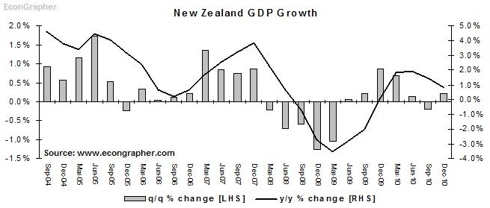
The New Zealand economy grew 0.2% q/q in the December 2010 quarter (-0.2% 3Q10), placing it up 0.8% year on year (1.5% 3Q10). The strongest sectors on a quarterly basis were fishing, forestry and mining, manufacturing, construction, and personal and community services. While the worst performing sectors were wholesale trade, retail, accommodation and restaurants, and utilities. So it was basically the primary sectors doing well, with the consumer sector still struggling. Thus the results overall were hardly spectacular, but the outlook is more promising, with the earthquake rebuilding effort likely to start making positive contributions as early as H2 2011. In addition, the Rugby World Cup will also add tourism revenues and boost the consumer sector. High agricultural commodities will boost the primary exporting sector, particularly dairy. And loose monetary policy will also assist the economic recovery.

4. UK CPI
The United Kingdom fell prey to the global inflation trend, with its annual CPI inflation rate rise to 4.4% in February this year, beating expectations of 4.2%, and rising from 4.0% in January. The figure will no doubt irk the Bank of England, which is likely to come under increasing pressure to raise rates from excessively stimulatory levels (0.50%). Indeed, in its most recent meeting minutes the Bank of England noted it is likely that inflation will rise to as much as 5% or more, before normalizing, with the Bank expecting inflation to fall back to the official inflation target of 2% in 2012. Inflation in the UK is still being boosted by the one-off effect of sales tax rises, and the impact of strong commodity prices. While these are in theory one-off/temporary effects, there is still a risk that inflation expectations may rise. Provided the economic situation doesn't materially deteriorate it is likely the BoE will start normalizing monetary policy before long.

5. Monetary Policy
The week in monetary policy was characterized by further emerging market monetary policy tightening with the following central banks lifting policy rates: Nigeria +100bps to 7.50%, Kenya +25bps to 6.00%, Uruguay +100bps to 7.50%, and the Philippines +25bps to 4.25%. Meanwhile two Central Banks held their policy rates, but tightened reserve requirements; Turkey +300bps to 15%, and Russia +100bps to 5.5% (and +50bps to 4%). For emerging markets, monetary policy continues to be the wild card. If emerging markets are able to tackle the inflation challenge successfully without growth taking too much of a hit then emerging market equities are likely to bring in strong returns - especially coming off current modest/reasonable valuation levels. However the obvious flip side is the policy risk puzzle, with the possibility of hard landings coming from over-tightening.


Summary

So we saw the US revising its GDP growth numbers upward as the US economy gained momentum, with all signs pointing to a strong 2011 - but with due downside risks. France likewise upgraded its GDP numbers in Q4 2010, but with momentum rising, also showed signs of rising inflationary pressures. Meanwhile New Zealand reported a marginally positive but relatively weak Q4 GDP result, but with the conditions coming into place to support a strong 2011, particularly in the later half of the year. Over to the UK, British inflation rose further, adding increasing pressure on the Bank of England to start normalizing monetary policy. While emerging markets continued their monetary policy tightening campaign to rein in rising inflation on the back of commodity prices and strong economic growth.

Sources
1. US Bureau of Economic Analysis www.bea.gov
2. OECD Statistics Database stats.oecd.org
3. Statistics NZ www.stats.govt.nz
4. Trading Economics www.tradingeconomics.com
5. CentralBankNews.info www.centralbanknews.info

Article Source: http://www.econgrapher.com/top5graphs26mar11.html

Saturday, January 1, 2011

Top 5 Economics Graphs of the Week - 1 Jan 2011

This week we look at China PMI, US house prices, US consumer confidence, French GDP results, and Japan's unemployment and inflation situation.

1. China PMI
China recorded slightly lower PMI figures for December with the HSBC index falling to 54.4 from 55.3 and the CFLP index falling to 53.9 from 55.2. Clearly there are a few issues bubbling away i.e. a spike in inflation... and more importantly - how the authorities deal with it. That alone will be one of the biggest wild-cards for 2011.

2. US Housing
The US housing market saw further weakness with the October reading of the Case-Shiller index down both on a monthly and annual basis. There's not much else to say on this one, house prices ran ahead of themselves and the market needs to correct - further government measures may put a temporary floor under the market, but the question is how long would that be necessary before the fundamentals finally came around? Another couple of years of flat house prices wouldn't be a surprise.

3. US Confidence
US Consumer Confidence dipped slightly in December, dropping to 52.5 from 54.1, with the weakness being expressed in both the current conditions and futures expectations indexes. Similar story to the housing market really - when will the key fundamentals turnaround? High unemployment and stagnant house prices will continue to weigh on this one in the medium term.

4. France GDP
France saw its economy expand 0.3% q/q vs 0.6% in Q2, with some minor downward revisions. Net exports made a negative contribution, household consumption and government consumption both made a positive contribution. Most are forecasting about 0.4% GDP growth in Q4. So it's chugging along OK for the French economy, not as fast as the Germans, but they're getting there.

5. Japan unemployment and inflation
Japan saw another month of positive inflation in November - barely, with the CPI increasing 0.1% y/y vs 0.2% in October. Meanwhile unemployment stuck around 5% with a 5.1% reading for November. Still many a challenge for Japan - but will the policy makers get it right? (for that matter what else is there left for them to do?)

Summary

So we saw China show a lower PMI figure on the back of uncertainty about the inflation battle. Over in the US there were no positive signs for the housing market in terms of prices in the near term, and consumer confidence is still low - also reflecting where fundamentals are currently at, but let's see what 2011 brings. Then we looked at France's GDP growth, and saw that they're chugging along alright out of the recession. Meanwhile in Japan there's just barely some positive inflation, and unemployment is little changed. So there you go, the first issue of 2011, may the year ahead bring you much happiness, health and success - it's sure to be an interesting year!

Sources
1. CFLP www.chinawuliu.com.cn & Markit/HSBC www.markiteconomics.com & Yahoo Finance finance.yahoo.com
2. Standard & Poor's www.standardandpoors.com
3. US Conference Board www.conference-board.org & US Bureau of Labor Statistics www.bls.gov
4. OECD Statistics Database stats.oecd.org/index.aspx
5. Trading Economics www.tradingeconomics.com


Article Source: http://www.econgrapher.com/top5graphs1jan11.html